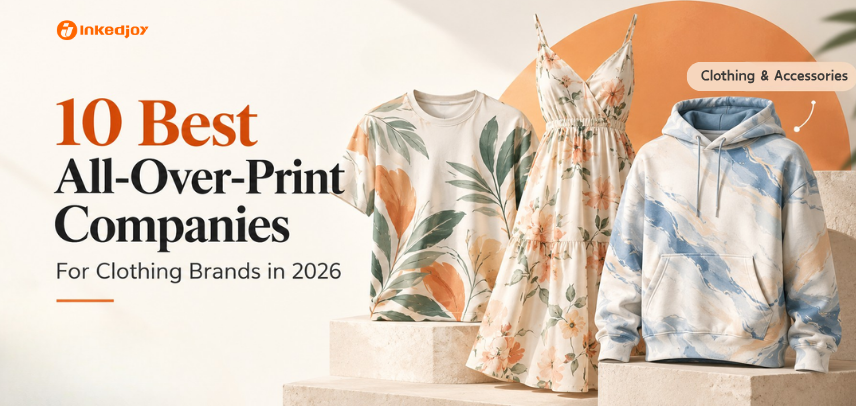
10 Best All-Over-Print Companies for Clothing Brands

10 Best All-Over-Print Companies for Clothing Brands

Oct 23, 2026 by Gina POD e-Commerce 101

Finding an all-over-print supplier isn't difficult. Finding one that can actually produce the clothing you have in mind is another story.

Some companies have enormous catalogs of affordable printed clothing, but limited fabric options. Others specialize in particular garments or offer more control over materials and construction, usually at a higher price.

We've compared 10 all-over-print (AOP) companies for clothing brands and print on demand sellers, looking at their products, printing methods, fulfillment, and branding services. We'll also cover what to check before ordering samples or committing to a new clothing line.

Quick Comparison

The companies below take different approaches to all-over printing. Some are primarily clothing suppliers, while others operate broader POD catalogs or networks of print providers.

Supplier AOP Print Coverage US Shipping Fulfillment Custom Branding
Inkedjoy Full Coverage 7–12 days   CN/US/AU facilities Yes
Contrado Full Coverage / Seam-Matched Print 2–3 days UK-based in-house production Yes
Printful Full Coverage / Seam-Matched Print 3–4 days Global production facilities Yes
Printify Full Coverage / Seam-Matched Print Provider-dependent Global network Provider-dependent
Subliminator Full Coverage 6–9 days China in-house production Litmited
Merchize Full Coverage 4–7 days  Vietnam-based production Yes
Yoycol Full Coverage 8-15 days China-based fulfillment Clothing products only
PrintKK Full Coverage 4–15  days China-based fulfillment Litmited
PeaPrint Full Coverage 7-25 days China-based fulfillment Litmited
Gooten Full Coverage Up to 12 days Third-party network Litmited (product-dependent)

Note: Full Coverage means the design can cover the garment but does not guarantee precise pattern alignment across seams. Shipping estimates refer to US delivery and exclude production time. Actual times vary by product, shipping method, and fulfillment location.

10 Best All-Over-Print Companies for Clothing Brands

1. Inkedjoy — Best for Affordable AOP Fashion Collections

Inkedjoy has an extensive catalog that goes well beyond regular T-shirts and hoodies. You’ll find dresses, swimwear, activewear, shoes, bags, and plenty of accessories, with many products priced toward the affordable end of the POD market.

Custom branding is another notable feature. We offers clothing labels, hang tags, and branded packaging on eligible products, so sellers aren’t limited to shipping generic merchandise. 

AOP Quick Facts

  • Fabric options: Primarily polyester and polyester-spandex blends.
  • Product variety: Everyday clothing, fashion apparel, footwear, bags, and accessories.
  • Branding: Custom label, hangtag, packaging, gift card, scotch tape available
Pros
  • More Affordable AOP apparel
  • 1500+ customizable products
  • Custom labels and packaging
  • Bulk Design for time saving
 
Cons
  • Longer international delivery
  • No guaranteed precise seam matching

Our Take

  • Best for: Multi-category clothing stores wanting affordable AOP and custom branding.
  • Not Ideal for: Brands prioritizing fast domestic fulfillment or exact pattern alignment.

2. Contrado — Best for Premium Custom Fashion

Contrado is quite different from the budget AOP platforms here. Based in the UK, it prints fabric and produces custom clothing in-house, with a much broader material selection than typical polyester-focused POD suppliers.

Its range includes dresses, jackets, leggings, tees, and other fashion products. Custom labels and white-label services are also available. 

AOP Quick Facts

  • Production: In-house fabric printing, cutting, and garment assembly in the UK.
  • Materials: Extensive fabric choices across custom clothing and printed textiles.
  • Branding: Custom labels and white-label services for eligible products.
Pros
  • Extensive fabric selection
  • In-house clothing production
  • Designer-oriented styles
  • Custom labels & white-label options
 
Cons
  • Premium pricing
  • Product-template limitations

Our Take

  • Best for: Premium fashion labels emphasizing materials, presentation, and UK production.
  • Not Ideal for: Low-price novelty apparel stores or sellers minimizing production cost.

3. Printful — Best for Branded AOP Fulfillment

Printful is one of the better-known names in POD, and its AOP offering has an important distinction: it isn’t limited to synthetic fabrics. Alongside traditional sublimated apparel, Printful offers an All-Over Cotton collection using water-based pigment printing.

Designs are printed onto fabric before the pieces are cut and sewn. Printful also has established store integrations, design tools, and branding services.

Prices are generally higher than those of many China-based AOP suppliers, especially for specialized clothing.

AOP Quick Facts

  • All-Over Cotton: Cotton-based tees, dresses, hoodies, and other selected garments.
  • Synthetic AOP: Sublimation printing on polyester-based material.
  • Design tools: Artwork templates, mockups, and order management.
Pros
  • Cotton and synthetic AOP options
  • Established ecommerce integrations
  • In-house AOP production
  • Custom branding services
 
Cons
  • Higher base prices
  • Fewer niche fashion silhouettes
  • Product-dependent branding
  • Seam alignment not guaranteed

Our Take

  • Best for: Brands wanting cotton AOP, established fulfillment, and polished branding.
  • Not Ideal for: Budget stores chasing the lowest prices or unusual fashion styles.

4. Printify — Best for Comparing AOP Print Providers

Printify isn’t a manufacturer in the usual sense. It’s a marketplace connecting sellers with print providers, each with its own products, prices, production facilities, and shipping arrangements.

That distinction matters more for AOP than it might for a standard T-shirt. A hoodie from one provider can have different fabric, construction, sizing, and templates from another. 

The upside is flexibility, including selected US-based production. The downside is that you need to do more of the supplier comparison yourself.

AOP Quick Facts

  • Provider network: Independent production partners with separate specifications.
  • AOP selection: T-shirts, jerseys, hoodies, dresses, leggings, and accessories.
  • Pricing model: Free access, with optional Premium discounts.
Pros
  • Multiple sourcing options
  • Selected US-based production
  • Provider-level information
  • Broad ecommerce integrations
 
Cons
  • Provider-dependent specifications
  • Uneven provider availability
  • Branding varies by provider
  • More sourcing research required

Our Take

  • Best for: Sellers comparing print providers, especially when production location matters.
  • Not Ideal for: Brands wanting one consistent manufacturer across an AOP collection.

5. Subliminator — Best for AOP-Focused Clothing Stores

Subliminator takes a more specialized approach than general POD marketplaces. Its offering is centered on all-over-print merchandise, with hoodies and leggings among its clothing products.

It makes more sense for a store built around bold, full-surface artwork than one selling mostly conventional logo apparel. The product selection emphasizes designs covering entire garments rather than small graphics on ready-made blanks.

AOP Quick Facts

  • Main focus: Full-surface printed clothing and complementary merchandise.
  • Clothing styles: Hoodies, leggings, and graphics-led apparel.
  • Store connections: Shopify and Etsy integrations.
Pros
  • AOP-focused catalog
  • Full-surface graphic clothing
  • No-inventory selling model
 
Cons
  • Limited conventional blank apparel
  • Fixed garment templates
  • Product-specific branding limitations

Our Take

  • Best for: Niche merchandise stores and brands built around bold AOP graphics.
  • Not for: Brands needing broad fabric choice or highly customized garment construction.

6. Yoycol — Best for Women’s Fashion and Activewear

Yoycol is particularly interesting for women’s fashion. Its clothing catalog includes an extensive dress selection, from casual styles and bodycon silhouettes to more distinctive pieces, alongside swimwear, leggings, and other activewear.

It also offers some cotton AOP products, worth a look if you don’t want an entirely polyester-based collection. 

AOP Quick Facts

  • Dress selection: Casual, fitted, sleeveless, and fashion-oriented silhouettes.
  • Materials: Polyester blends and selected cotton products.
  • Order discounts: Quantity pricing on selected products.
Pros
  • Extensive dress styles
  • Strong women’s fashion selection
  • Selected cotton AOP apparel
  • Quantity discounts
 
Cons
  • Different fabric specifications between styles
  • Longer shipping and production time than other POD supplier
  • Product-specific customization limits

Our Take

  • Best for: Women’s fashion stores selling dresses, swimwear, fitted clothing, and activewear.
  • Not for: Brands requiring standardized garment materials and specifications.

7. PrintKK — Best for Niche AOP Product Testing

PrintKK is worth browsing if you’re looking for some print on demand niches. Its catalog includes dresses, leggings, shirts, pajamas, accessories, and other customizable products.

Starting prices are often low, although the final cost depends on what you order and where it ships. Product variety is considerable, but material specifications and construction aren’t necessarily consistent across similar items.

AOP Quick Facts

  • Product selection: Clothing, accessories, home goods, and lifestyle merchandise.
  • Materials: Product-dependent, including polyester-spandex blends.
  • Selling model: On-demand fulfillment with store integrations.
Pros
  • 1300+ customizable products
  • Multiple apparel categories
 
Cons
  • Limited product-level branding clarity
  • Longer delivery times

Our Take

  • Best for: New POD sellers testing designs across clothing and accessories.
  • Not for: Brands needing a tightly controlled signature collection.

8. PeaPrint — Best for Expanding AOP Clothing Collections

PeaPrint is another supplier with a large selection of AOP apparel. There are dresses, hoodies, shirts, jackets, and accessories, including clothing that moves beyond the usual lightweight polyester products.

What makes PeaPrint worth checking is the variety within its clothing categories. Different garment constructions and fabric weights give sellers more options for seasonal collections. 

AOP Quick Facts

  • Clothing range: Dresses, hoodies, casual shirts, jackets, and accessories.
  • Fabric selection: Polyester-based apparel and selected cotton products.
  • Product information: Fabric composition and printing details on individual product pages.
Pros
  • Extensive AOP clothing selection
  • Multiple garment styles and weights
  • Selected cotton clothing options
 
Cons
  • Varying material specifications
  • Product-dependent branding
  • High Individual Shipping Costs

Our Take

  • Best for: Sellers expanding basic AOP T-shirt offerings into seasonal apparel and new fashion styles.
  • Not for: Brands seeking standardized products or fast local fulfillment.

9. Merchize — Best for Casual and Seasonal AOP Apparel

Merchize has a varied POD catalog, but its AOP casualwear is particularly worth exploring. Hawaiian shirts, button-downs, and other sublimated apparel are a natural fit for vacation designs, novelty prints, and seasonal collections.

Merchize also offers different fulfillment arrangements, with production locations depending on the product. One detail to watch is pricing: some listings include shipping while others separate it. 

AOP Quick Facts

  • Casualwear focus: Hawaiian shirts, button-down shirts, and printed tees.
  • Typical materials: Polyester-based fabric for many sublimated styles.
  • Pricing details: Some listings include shipping in the displayed price.
Pros
  • Casual and vacation apparel
  • Competitive listed prices
  • Multiple fulfillment arrangements
 
Cons
  • Polyester-heavy AOP range
  • Different pricing formats
  • SKU-dependent production locations
  • Limited premium fabrics

Our Take

  • Best for: Vacation clothing, seasonal merchandise, and casual graphic apparel sellers.
  • Not for: Premium brands centered on natural fabrics or custom tailoring.

10. Gooten — Best for Stores Adding AOP to a Larger Catalog

Gooten is primarily a fulfillment platform rather than a fashion-focused supplier. Its range spans home goods, accessories, and apparel, including AOP leggings, pajamas, sweatshirts, and hoodies.

Some garments use cut-and-sew construction with polyester fabric, and Gooten provides artwork templates showing print areas. Its AOP selection isn’t as fashion-heavy as Inkedjoy or PeaPrint, but that may not matter to a personalized-merchandise store.

Its wider order-management setup also suits stores handling multiple categories.

AOP Quick Facts

  • AOP apparel: Leggings, pajamas, hoodies, sweatshirts, and selected accessories.
  • Product templates: Artwork guidelines with bleed and safe areas.
  • Garment materials: Selected cut-and-sew hoodies use 100% polyester.
Pros
  • Established fulfillment platform
  • Apparel and home goods together
  • Detailed artwork templates
  • More ntegrations available
 
Cons
  • Limited fashion AOP styles
  • Fewer fabric options
  • Product-specific fulfillment details
  • Limited clothing customization

Our Take

  • Best for: Merchandise stores adding AOP clothing to other personalized products.
  • Not for: Fashion-first brands seeking dresses, woven clothing, or distinctive silhouettes.

How Do You Choose the Right AOP Supplier for Your Clothing Line?

The fabric and garment matter just as much as the company producing them. A supplier with hundreds of AOP products may still be a poor match if your design needs materials or construction it doesn’t offer.

Match the Printing Method to Your Fabric

All-over print describes design coverage, not a single printing technology.

Clothing Type Typical Fabric Printing Approach
Activewear and swimwear Polyester / spandex Sublimation, often followed by cut-and-sew
Cotton casualwear Cotton / cotton blends Compatible full-fabric pigment or other textile printing
Dresses and woven apparel Cotton, polyester, blends Fabric-dependent printing and construction
Hoodies and sweatpants Cotton fleece / polyester fleece Depends on fabric and construction
Bags and accessories Various materials Product-specific printing methods

Sublimation works particularly well on polyester, which explains its popularity among affordable AOP suppliers. Cotton needs a different approach.

Does Cut-and-Sew Guarantee Perfect Seam Alignment?

No. Cut-and-sew allows printed fabric to cover the garment more completely, but it doesn’t guarantee stripes, letters, or geometric artwork will line up across sleeves and side seams.

Small variations can occur during printing, cutting, and sewing. Repeating patterns and scattered illustrations are usually more forgiving.

If matching across seams is essential, ask the manufacturer about its capabilities before ordering; this level of precision may require a more specialized, expensive process.

How Do You Test an All-Over-Print Supplier?

A mockup is useful for presentation, but it won’t tell you everything about the finished garment. Order samples of the products you intend to sell, particularly when fit, fabric, or placement is important.

What to Check How to Test Watch For
Print coverage Inspect collars, sleeves, underarms, and seams White gaps or missing print
Pattern placement Examine graphics crossing garment panels Unacceptable misalignment
Fabric Compare sample with product specifications Unexpected texture or weight
Wash durability Wash according to care label Fading, distortion, or print damage
Stretch Gently stretch activewear Visible print changes or damage
Fulfillment Place an order through the normal process Incorrect sizes, delays, or packaging issues

Expert Tip: Don’t test only forgiving designs. A detailed geometric pattern or artwork with positioned elements may expose placement issues that abstract prints hide. The goal is to understand what a supplier can reproduce and choose designs within those limits.

What Should You Check Before Scaling Your AOP Brand?

A good sample doesn’t tell you whether a supplier will be convenient to work with once orders become regular.

Start with costs. Compare the garments you’ll actually sell, including shipping and branding charges. The lowest advertised product price won’t always produce the best margin.

Check delivery expectations. Production and shipping are separate stages, and fulfillment locations can vary within one platform. Don’t build your delivery promises around the fastest advertised estimate.

Look at operational details. Confirm your main products support the labels or packaging you need, and understand how misprints and damaged orders are handled.

Which All-Over-Print Company Should You Choose?

For affordable, multi-category AOP clothing, Inkedjoy are useful starting points. Printful is worth considering for cotton AOP and its fulfillment tools, while Contrado offers a more compelling proposition for premium designer clothing.

There isn’t one best supplier for every brand. Start with your intended products, narrow the options based on materials and construction, and order samples before making them a permanent part of your collection.

Frequently Asked Questions

What is the best company for all-over-print clothing?

It depends on your collection. Inkedjoy, Yoycol, and PeaPrint offer affordable AOP fashion options. Printful is worth considering for cotton AOP and integrated fulfillment, while Contrado focuses on premium custom clothing.

Which print-on-demand companies offer cut-and-sew AOP?

Printful, Contrado, Gooten, and other AOP suppliers offer selected cut-and-sew products. Production methods vary by garment, so check individual product pages rather than assuming a whole catalog uses the same construction.

Can all-over printing be done on cotton?

Yes. Cotton AOP uses different methods from conventional polyester sublimation. Printful offers full-coverage cotton garments printed with water-based pigment inks before cutting and sewing. Fabric choices vary by supplier.

Is all-over printing more expensive than regular printing?

Often, yes. AOP may involve larger print areas, fabric handling, cutting, and sewing rather than decorating a ready-made blank. Costs still vary widely across materials, garments, and suppliers.

Can I sell all-over-print clothing with no minimum order?

Yes. Many POD suppliers offer individual AOP garments without minimum order quantities. Custom labeling and specialized production may involve additional fees or requirements.

Does all-over print mean patterns will match perfectly at the seams?

No. Full-coverage printing does not guarantee precise seam alignment. If a design depends on matching lines or graphics across garment panels, check the supplier’s restrictions and order samples.

G

Written By Gina

A skilled marketing specialist with expertise in e-commerce marketing, and print-on-demand product research. She has extensive experience in keyword research, market analysis, and content strategy, helping brands find uncover profitable opportunities, improve search visibility, and drive sustainable growth through data-driven marketing.

Editorial note: This is a comparison of supplier-published product information and service descriptions, not an independently tested quality ranking. Fabric, printing method, branding eligibility, production time, and shipping options vary by SKU. All-over coverage does not imply guaranteed seam matching. Check current product details before ordering.

Like the article

0
10 Best All-Over-Print Companies for Clothing Brands

10 Best All-Over-Print Companies for Clothing Brands

Finding an all-over-print supplier isn't difficult. Finding one that can actually produce the clothing you have in mind is another story.

Some companies have enormous catalogs of affordable printed clothing, but limited fabric options. Others specialize in particular garments or offer more control over materials and construction, usually at a higher price.

We've compared 10 all-over-print (AOP) companies for clothing brands and print on demand sellers, looking at their products, printing methods, fulfillment, and branding services. We'll also cover what to check before ordering samples or committing to a new clothing line.

Quick Comparison

The companies below take different approaches to all-over printing. Some are primarily clothing suppliers, while others operate broader POD catalogs or networks of print providers.

Supplier AOP Print Coverage US Shipping Fulfillment Custom Branding
Inkedjoy Full Coverage 7–12 days   CN/US/AU facilities Yes
Contrado Full Coverage / Seam-Matched Print 2–3 days UK-based in-house production Yes
Printful Full Coverage / Seam-Matched Print 3–4 days Global production facilities Yes
Printify Full Coverage / Seam-Matched Print Provider-dependent Global network Provider-dependent
Subliminator Full Coverage 6–9 days China in-house production Litmited
Merchize Full Coverage 4–7 days  Vietnam-based production Yes
Yoycol Full Coverage 8-15 days China-based fulfillment Clothing products only
PrintKK Full Coverage 4–15  days China-based fulfillment Litmited
PeaPrint Full Coverage 7-25 days China-based fulfillment Litmited
Gooten Full Coverage Up to 12 days Third-party network Litmited (product-dependent)

Note: Full Coverage means the design can cover the garment but does not guarantee precise pattern alignment across seams. Shipping estimates refer to US delivery and exclude production time. Actual times vary by product, shipping method, and fulfillment location.

10 Best All-Over-Print Companies for Clothing Brands

1. Inkedjoy — Best for Affordable AOP Fashion Collections

Inkedjoy has an extensive catalog that goes well beyond regular T-shirts and hoodies. You’ll find dresses, swimwear, activewear, shoes, bags, and plenty of accessories, with many products priced toward the affordable end of the POD market.

Custom branding is another notable feature. We offers clothing labels, hang tags, and branded packaging on eligible products, so sellers aren’t limited to shipping generic merchandise. 

AOP Quick Facts

  • Fabric options: Primarily polyester and polyester-spandex blends.
  • Product variety: Everyday clothing, fashion apparel, footwear, bags, and accessories.
  • Branding: Custom label, hangtag, packaging, gift card, scotch tape available
Pros
  • More Affordable AOP apparel
  • 1500+ customizable products
  • Custom labels and packaging
  • Bulk Design for time saving
 
Cons
  • Longer international delivery
  • No guaranteed precise seam matching

Our Take

  • Best for: Multi-category clothing stores wanting affordable AOP and custom branding.
  • Not Ideal for: Brands prioritizing fast domestic fulfillment or exact pattern alignment.

2. Contrado — Best for Premium Custom Fashion

Contrado is quite different from the budget AOP platforms here. Based in the UK, it prints fabric and produces custom clothing in-house, with a much broader material selection than typical polyester-focused POD suppliers.

Its range includes dresses, jackets, leggings, tees, and other fashion products. Custom labels and white-label services are also available. 

AOP Quick Facts

  • Production: In-house fabric printing, cutting, and garment assembly in the UK.
  • Materials: Extensive fabric choices across custom clothing and printed textiles.
  • Branding: Custom labels and white-label services for eligible products.
Pros
  • Extensive fabric selection
  • In-house clothing production
  • Designer-oriented styles
  • Custom labels & white-label options
 
Cons
  • Premium pricing
  • Product-template limitations

Our Take

  • Best for: Premium fashion labels emphasizing materials, presentation, and UK production.
  • Not Ideal for: Low-price novelty apparel stores or sellers minimizing production cost.

3. Printful — Best for Branded AOP Fulfillment

Printful is one of the better-known names in POD, and its AOP offering has an important distinction: it isn’t limited to synthetic fabrics. Alongside traditional sublimated apparel, Printful offers an All-Over Cotton collection using water-based pigment printing.

Designs are printed onto fabric before the pieces are cut and sewn. Printful also has established store integrations, design tools, and branding services.

Prices are generally higher than those of many China-based AOP suppliers, especially for specialized clothing.

AOP Quick Facts

  • All-Over Cotton: Cotton-based tees, dresses, hoodies, and other selected garments.
  • Synthetic AOP: Sublimation printing on polyester-based material.
  • Design tools: Artwork templates, mockups, and order management.
Pros
  • Cotton and synthetic AOP options
  • Established ecommerce integrations
  • In-house AOP production
  • Custom branding services
 
Cons
  • Higher base prices
  • Fewer niche fashion silhouettes
  • Product-dependent branding
  • Seam alignment not guaranteed

Our Take

  • Best for: Brands wanting cotton AOP, established fulfillment, and polished branding.
  • Not Ideal for: Budget stores chasing the lowest prices or unusual fashion styles.

4. Printify — Best for Comparing AOP Print Providers

Printify isn’t a manufacturer in the usual sense. It’s a marketplace connecting sellers with print providers, each with its own products, prices, production facilities, and shipping arrangements.

That distinction matters more for AOP than it might for a standard T-shirt. A hoodie from one provider can have different fabric, construction, sizing, and templates from another. 

The upside is flexibility, including selected US-based production. The downside is that you need to do more of the supplier comparison yourself.

AOP Quick Facts

  • Provider network: Independent production partners with separate specifications.
  • AOP selection: T-shirts, jerseys, hoodies, dresses, leggings, and accessories.
  • Pricing model: Free access, with optional Premium discounts.
Pros
  • Multiple sourcing options
  • Selected US-based production
  • Provider-level information
  • Broad ecommerce integrations
 
Cons
  • Provider-dependent specifications
  • Uneven provider availability
  • Branding varies by provider
  • More sourcing research required

Our Take

  • Best for: Sellers comparing print providers, especially when production location matters.
  • Not Ideal for: Brands wanting one consistent manufacturer across an AOP collection.

5. Subliminator — Best for AOP-Focused Clothing Stores

Subliminator takes a more specialized approach than general POD marketplaces. Its offering is centered on all-over-print merchandise, with hoodies and leggings among its clothing products.

It makes more sense for a store built around bold, full-surface artwork than one selling mostly conventional logo apparel. The product selection emphasizes designs covering entire garments rather than small graphics on ready-made blanks.

AOP Quick Facts

  • Main focus: Full-surface printed clothing and complementary merchandise.
  • Clothing styles: Hoodies, leggings, and graphics-led apparel.
  • Store connections: Shopify and Etsy integrations.
Pros
  • AOP-focused catalog
  • Full-surface graphic clothing
  • No-inventory selling model
 
Cons
  • Limited conventional blank apparel
  • Fixed garment templates
  • Product-specific branding limitations

Our Take

  • Best for: Niche merchandise stores and brands built around bold AOP graphics.
  • Not for: Brands needing broad fabric choice or highly customized garment construction.

6. Yoycol — Best for Women’s Fashion and Activewear

Yoycol is particularly interesting for women’s fashion. Its clothing catalog includes an extensive dress selection, from casual styles and bodycon silhouettes to more distinctive pieces, alongside swimwear, leggings, and other activewear.

It also offers some cotton AOP products, worth a look if you don’t want an entirely polyester-based collection. 

AOP Quick Facts

  • Dress selection: Casual, fitted, sleeveless, and fashion-oriented silhouettes.
  • Materials: Polyester blends and selected cotton products.
  • Order discounts: Quantity pricing on selected products.
Pros
  • Extensive dress styles
  • Strong women’s fashion selection
  • Selected cotton AOP apparel
  • Quantity discounts
 
Cons
  • Different fabric specifications between styles
  • Longer shipping and production time than other POD supplier
  • Product-specific customization limits

Our Take

  • Best for: Women’s fashion stores selling dresses, swimwear, fitted clothing, and activewear.
  • Not for: Brands requiring standardized garment materials and specifications.

7. PrintKK — Best for Niche AOP Product Testing

PrintKK is worth browsing if you’re looking for some print on demand niches. Its catalog includes dresses, leggings, shirts, pajamas, accessories, and other customizable products.

Starting prices are often low, although the final cost depends on what you order and where it ships. Product variety is considerable, but material specifications and construction aren’t necessarily consistent across similar items.

AOP Quick Facts

  • Product selection: Clothing, accessories, home goods, and lifestyle merchandise.
  • Materials: Product-dependent, including polyester-spandex blends.
  • Selling model: On-demand fulfillment with store integrations.
Pros
  • 1300+ customizable products
  • Multiple apparel categories
 
Cons
  • Limited product-level branding clarity
  • Longer delivery times

Our Take

  • Best for: New POD sellers testing designs across clothing and accessories.
  • Not for: Brands needing a tightly controlled signature collection.

8. PeaPrint — Best for Expanding AOP Clothing Collections

PeaPrint is another supplier with a large selection of AOP apparel. There are dresses, hoodies, shirts, jackets, and accessories, including clothing that moves beyond the usual lightweight polyester products.

What makes PeaPrint worth checking is the variety within its clothing categories. Different garment constructions and fabric weights give sellers more options for seasonal collections. 

AOP Quick Facts

  • Clothing range: Dresses, hoodies, casual shirts, jackets, and accessories.
  • Fabric selection: Polyester-based apparel and selected cotton products.
  • Product information: Fabric composition and printing details on individual product pages.
Pros
  • Extensive AOP clothing selection
  • Multiple garment styles and weights
  • Selected cotton clothing options
 
Cons
  • Varying material specifications
  • Product-dependent branding
  • High Individual Shipping Costs

Our Take

  • Best for: Sellers expanding basic AOP T-shirt offerings into seasonal apparel and new fashion styles.
  • Not for: Brands seeking standardized products or fast local fulfillment.

9. Merchize — Best for Casual and Seasonal AOP Apparel

Merchize has a varied POD catalog, but its AOP casualwear is particularly worth exploring. Hawaiian shirts, button-downs, and other sublimated apparel are a natural fit for vacation designs, novelty prints, and seasonal collections.

Merchize also offers different fulfillment arrangements, with production locations depending on the product. One detail to watch is pricing: some listings include shipping while others separate it. 

AOP Quick Facts

  • Casualwear focus: Hawaiian shirts, button-down shirts, and printed tees.
  • Typical materials: Polyester-based fabric for many sublimated styles.
  • Pricing details: Some listings include shipping in the displayed price.
Pros
  • Casual and vacation apparel
  • Competitive listed prices
  • Multiple fulfillment arrangements
 
Cons
  • Polyester-heavy AOP range
  • Different pricing formats
  • SKU-dependent production locations
  • Limited premium fabrics

Our Take

  • Best for: Vacation clothing, seasonal merchandise, and casual graphic apparel sellers.
  • Not for: Premium brands centered on natural fabrics or custom tailoring.

10. Gooten — Best for Stores Adding AOP to a Larger Catalog

Gooten is primarily a fulfillment platform rather than a fashion-focused supplier. Its range spans home goods, accessories, and apparel, including AOP leggings, pajamas, sweatshirts, and hoodies.

Some garments use cut-and-sew construction with polyester fabric, and Gooten provides artwork templates showing print areas. Its AOP selection isn’t as fashion-heavy as Inkedjoy or PeaPrint, but that may not matter to a personalized-merchandise store.

Its wider order-management setup also suits stores handling multiple categories.

AOP Quick Facts

  • AOP apparel: Leggings, pajamas, hoodies, sweatshirts, and selected accessories.
  • Product templates: Artwork guidelines with bleed and safe areas.
  • Garment materials: Selected cut-and-sew hoodies use 100% polyester.
Pros
  • Established fulfillment platform
  • Apparel and home goods together
  • Detailed artwork templates
  • More ntegrations available
 
Cons
  • Limited fashion AOP styles
  • Fewer fabric options
  • Product-specific fulfillment details
  • Limited clothing customization

Our Take

  • Best for: Merchandise stores adding AOP clothing to other personalized products.
  • Not for: Fashion-first brands seeking dresses, woven clothing, or distinctive silhouettes.

How Do You Choose the Right AOP Supplier for Your Clothing Line?

The fabric and garment matter just as much as the company producing them. A supplier with hundreds of AOP products may still be a poor match if your design needs materials or construction it doesn’t offer.

Match the Printing Method to Your Fabric

All-over print describes design coverage, not a single printing technology.

Clothing Type Typical Fabric Printing Approach
Activewear and swimwear Polyester / spandex Sublimation, often followed by cut-and-sew
Cotton casualwear Cotton / cotton blends Compatible full-fabric pigment or other textile printing
Dresses and woven apparel Cotton, polyester, blends Fabric-dependent printing and construction
Hoodies and sweatpants Cotton fleece / polyester fleece Depends on fabric and construction
Bags and accessories Various materials Product-specific printing methods

Sublimation works particularly well on polyester, which explains its popularity among affordable AOP suppliers. Cotton needs a different approach.

Does Cut-and-Sew Guarantee Perfect Seam Alignment?

No. Cut-and-sew allows printed fabric to cover the garment more completely, but it doesn’t guarantee stripes, letters, or geometric artwork will line up across sleeves and side seams.

Small variations can occur during printing, cutting, and sewing. Repeating patterns and scattered illustrations are usually more forgiving.

If matching across seams is essential, ask the manufacturer about its capabilities before ordering; this level of precision may require a more specialized, expensive process.

How Do You Test an All-Over-Print Supplier?

A mockup is useful for presentation, but it won’t tell you everything about the finished garment. Order samples of the products you intend to sell, particularly when fit, fabric, or placement is important.

What to Check How to Test Watch For
Print coverage Inspect collars, sleeves, underarms, and seams White gaps or missing print
Pattern placement Examine graphics crossing garment panels Unacceptable misalignment
Fabric Compare sample with product specifications Unexpected texture or weight
Wash durability Wash according to care label Fading, distortion, or print damage
Stretch Gently stretch activewear Visible print changes or damage
Fulfillment Place an order through the normal process Incorrect sizes, delays, or packaging issues

Expert Tip: Don’t test only forgiving designs. A detailed geometric pattern or artwork with positioned elements may expose placement issues that abstract prints hide. The goal is to understand what a supplier can reproduce and choose designs within those limits.

What Should You Check Before Scaling Your AOP Brand?

A good sample doesn’t tell you whether a supplier will be convenient to work with once orders become regular.

Start with costs. Compare the garments you’ll actually sell, including shipping and branding charges. The lowest advertised product price won’t always produce the best margin.

Check delivery expectations. Production and shipping are separate stages, and fulfillment locations can vary within one platform. Don’t build your delivery promises around the fastest advertised estimate.

Look at operational details. Confirm your main products support the labels or packaging you need, and understand how misprints and damaged orders are handled.

Which All-Over-Print Company Should You Choose?

For affordable, multi-category AOP clothing, Inkedjoy are useful starting points. Printful is worth considering for cotton AOP and its fulfillment tools, while Contrado offers a more compelling proposition for premium designer clothing.

There isn’t one best supplier for every brand. Start with your intended products, narrow the options based on materials and construction, and order samples before making them a permanent part of your collection.

Frequently Asked Questions

What is the best company for all-over-print clothing?

It depends on your collection. Inkedjoy, Yoycol, and PeaPrint offer affordable AOP fashion options. Printful is worth considering for cotton AOP and integrated fulfillment, while Contrado focuses on premium custom clothing.

Which print-on-demand companies offer cut-and-sew AOP?

Printful, Contrado, Gooten, and other AOP suppliers offer selected cut-and-sew products. Production methods vary by garment, so check individual product pages rather than assuming a whole catalog uses the same construction.

Can all-over printing be done on cotton?

Yes. Cotton AOP uses different methods from conventional polyester sublimation. Printful offers full-coverage cotton garments printed with water-based pigment inks before cutting and sewing. Fabric choices vary by supplier.

Is all-over printing more expensive than regular printing?

Often, yes. AOP may involve larger print areas, fabric handling, cutting, and sewing rather than decorating a ready-made blank. Costs still vary widely across materials, garments, and suppliers.

Can I sell all-over-print clothing with no minimum order?

Yes. Many POD suppliers offer individual AOP garments without minimum order quantities. Custom labeling and specialized production may involve additional fees or requirements.

Does all-over print mean patterns will match perfectly at the seams?

No. Full-coverage printing does not guarantee precise seam alignment. If a design depends on matching lines or graphics across garment panels, check the supplier’s restrictions and order samples.

G

Written By Gina

A skilled marketing specialist with expertise in e-commerce marketing, and print-on-demand product research. She has extensive experience in keyword research, market analysis, and content strategy, helping brands find uncover profitable opportunities, improve search visibility, and drive sustainable growth through data-driven marketing.

Editorial note: This is a comparison of supplier-published product information and service descriptions, not an independently tested quality ranking. Fabric, printing method, branding eligibility, production time, and shipping options vary by SKU. All-over coverage does not imply guaranteed seam matching. Check current product details before ordering.

Like the article

0