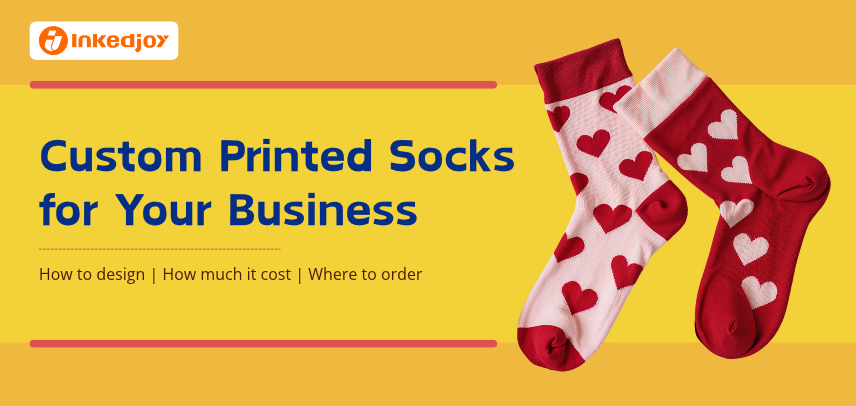
Custom Printed Socks for Your Business: Design, Costs & Where to Order

Custom Printed Socks for Your Business: Design, Costs & Where to Order

Nov 25, 2026 by Gina POD e-Commerce 101

Key Takeaways

  • Match fabric to artwork. Polyester suits full-color prints, while cotton blends suit everyday logo socks.
  • Check the minimum by size and design. Single pairs and bulk orders follow different rules.
  • Price the delivered pair. Include shipping and selling fees before setting your retail price.
  • Wear and wash a sample. Check fit, color, and logo placement before approving production.

A bold illustration can give shoppers a reason to pick up a pair of socks they’d otherwise walk past. A simple logo on a soft cotton-blend crew can do just as much for a company welcome kit.

What makes a good pair depends on who’s going to wear it and why they’re buying it.

Once you have a design in mind, a few practical questions come up. Will the fabric show the artwork clearly? Can you order one pair before committing to a batch?

And if a customer only buys one pair from your store, how much of the sale will shipping eat up? Here’s how to work through those decisions before placing your first order.

What Materials and Sizes Work Best for Custom Printed Socks?

Which material suits your design?

Start with what your customer is buying the socks for. Someone choosing a pair for its pet portrait will notice immediately if the dog’s face loses detail. Someone picking out everyday socks might care more about how the cuff feels after a few hours of wear. Those priorities point you toward different materials.

  • Polyester works well for colorful illustrations, photos, and all-over patterns. A polyester crew sock made for dye sublimation is a good place to test artwork with several colors or gradual shading.
  • Cotton blends are a good choice for soft everyday socks, including employee gifts and branded dress socks. Check the decoration method on the product page. Some cotton-rich styles have the logo knitted directly into the sock. 
  • Nylon is worth looking for in a blend when regular wear is a priority. You’ll find it in cotton-rich dress socks, where the buyer wants a soft hand and a pair that holds up in the weekly rotation. 
  • Spandex, also called elastane, adds stretch. On a fitted athletic sock, pay attention to how the cuff springs back and whether the artwork still looks right when stretched around the calf. 

A designer launching an illustrated collection can narrow the search to printable styles first, then compare how the samples feel. A business buying understated logo socks has more freedom to choose a favorite fabric and ask the supplier how it can reproduce the mark. That small change in the order of decisions saves a lot of catalog browsing.

What sizes should you order?

Size matters most when the buyer and the wearer are different people. A coach ordering for 25 players can collect shoe sizes in advance. An online gift shopper needs a chart clear enough to choose a pair for someone else.

Here’s an example from the Momentec Brands athletic sock chart. The inch measurements refer to the wearer’s foot length, measured from heel to toe. Use the chart for your specific product when building a store listing.

Sock size US youth shoe size US women’s shoe size US men’s/adult shoe size Foot length
XS 9–13 — — 6–7½ in.
S 1–3 4–5 — 7¾–8½ in.
M 4–7 5½–10½ 4½–7½ 8½–10 in.
L — 10½–12 8–13 10–11 in.
XL — — 13–15 11½–12½ in.

What about one-size socks? Ask for the shoe-size or foot-length range the style fits. A listing might describe a crew sock as 15.35 inches long. That measurement includes the leg, so copying it into a field labeled “foot length” would give shoppers the wrong idea about fit.

A team order is easiest to size with one question per player: “What shoe size do you wear, and is that youth, women’s, or men’s?” Match the answers to the supplier’s chart before requesting a quote. In an online shop, put the equivalent shoe sizes beside the size selector so customers can make the same decision without leaving the product page. 

Can You Order One Pair or a Small Batch of Custom Printed Socks?

Yes. Some printers accept a single pair with your own artwork. You can buy one to photograph, use a print-on-demand service to fulfill individual sales, or order a small batch to keep in stock. The right choice depends on where the next pair needs to go. 

If you’re still testing the design, order one finished pair. A stock sample can tell you whether you like the fabric and cushioning. To see if your smallest lettering is legible or your background color comes out as expected, you’ll need the actual artwork printed on the style you intend to sell. Ask which kind of sample you’re getting before paying for it. 

If customers will order through your store, look at how each sale gets fulfilled. A printer that lets you buy one pair may still expect you to upload the file and enter the address yourself. That’s manageable for a sample. Once several orders come in, a store connection can save you from re-entering those details. Personalized socks add one more question: how does each buyer’s photo or name reach the printer?

A small batch makes more sense when you need finished stock in hand. You might be selling at a weekend market, packing orders in your own branded boxes, or delivering every pair to a club on the same day. Before comparing batch prices, send the supplier your size and design breakdown.

That detail can change whether you qualify for the minimum order quantity (MOQ). One supplier accepts single pairs of printed socks but requires 12 pairs in the same size and colors for its knit athletic and dress styles. An order for 24 players can clear a 12-pair minimum on paper and still come up short in one size. 

How Much Do Custom Printed Socks Cost?

Inkedjoy lists its classic sublimated crew socks at $3.62 per pair before shipping. If you’re buying for a group, the following prices from one promotional supplier show what two athletic crew styles cost at three quantities. 

Price per pair 25 pairs 50 pairs 100 pairs
Ankle-logo crew $7.29 $6.87 $6.45
Full-color crew $8.53 $8.23 $7.85

A running club ordering 25 ankle-logo pairs would spend $182.25 on the socks. The full-color style comes to $213.25. Before quoting the club, ask what shipping, packaging, and any setup charges add to the bill. 

Buying stock for your shop? Divide the delivered total by the number of sellable pairs. Subtract that figure, selling fees, and any postage you cover from your retail price to see how much each sale leaves for other expenses.

Where to Order Custom Printed Socks

For Online Sock Shops

A print-on-demand supplier lets you list several designs and see which ones customers buy. Inkedjoy’s classic sublimated crew socks give illustrators an all-over print area and the option to connect a store. Once a design earns repeat orders, compare a batch quote with what you’re spending to fulfill those sales individually. 

For Team & Club Orders

A teamwear specialist can work from your roster, team colors, and first game date. Send the size breakdown with the badge so the quote covers the actual players, including anyone who needs a youth size. Ask about reorders while you’re at it. A player joining midseason might need just one matching pair. 

For Personalized Gifts

Look for a photo-sock printer that accepts a different image on every pair. Who crops the portrait, and does the buyer get to approve it? Try the service with an ordinary phone photo. A snapshot of a moving dog is a better test of your future customers’ experience than a studio portrait. 

For Corporate Swag & Event Merchandise

Promotional merchandise suppliers can quote a full run with branded wraps and delivery to one venue. Give them the date you need the boxes in hand. If your client requests US-made socks, ask where the specific style is manufactured and printed before including that claim in your proposal.

How to Prepare and Upload Your Design

  1. Download the template for your exact sock. Check the required pixel dimensions, resolution, and color profile. Inkedjoy recommends 531 × 1,654 px at 150 dpi or higher for its classic crew. Its shorter mini crew uses 531 × 1,299 px. 
  2. Fit the artwork to the print area. Keep lettering, faces, and logos inside the marked safe area. Extend the background through the bleed wherever the template calls for it. 
  3. Export and upload. Use the supplier’s accepted file format. A transparent PNG works for a standalone logo when you want the sock color to show around it. Select the correct style and size, then upload the file to its design tool. 
  4. Preview both socks. Check the orientation, crop, and text at roughly the size the artwork will appear on the finished pair. Review every printable view and save the version you approve. 

Where to Place a Logo or an All-Over Pattern

A logo needs to be recognizable when the sock is worn. On a crew sock, the outer leg just above the shoe collar is a good spot for a club badge or brand mark. Check that the style supports printing there. Some ankle-logo products include just one imprint position per foot. 

Want the badge to face outward on both legs? Ask for a side view of each sock with the toes pointing forward. That makes it easy to spot a placement that looks right on the left foot but turns inward on the right.

An all-over design gives you more space, though it’s worth checking where the pattern wraps around the leg. On socks printed flat, the front and back can meet slightly out of alignment. A pet portrait illustrates the issue well: keep each face within one print area and let the little paw prints fall along the join. A slight shift between paw prints is much harder to spot than one across the dog’s eyes. 

What to Check Before Placing Your Order

A dark streetwear sock can photograph beautifully and show pale lines the first time a customer pulls it on. Try the sample on, then wash it once before approving the run. 

  • Feel. Wear the socks with the shoes your customer is likely to use. Notice whether the cuff digs in, the toe seam rubs, or the fabric bunches underfoot.
  • Fit. Try the sample on someone within the listed shoe-size range. Check where the heel lands and how high the cuff sits. If one size covers a wide range, test the fit near both ends.
  • Print clarity. Read the smallest lettering while the sock is stretched. Look at the side join and heel, then take a photo in shoes to see how much of the design customers will actually see.
  • Color. Compare the pair with your approved artwork in daylight. If it needs to match an existing uniform or merchandise collection, put the two physical items side by side.
  • Wash performance. Follow the care instructions and compare the dry pair with a photo taken before washing. Check for fading and changes in fit. On styles with a surface-applied decoration, look for lifting or cracking around the edges.

Keep the approved pair if you plan to reorder. When a second batch arrives months later, having the original on hand makes it much easier to settle questions about cuff height, shade, or logo placement.

Before committing to a launch date, also confirm when the order will arrive. Inkedjoy lists 2–5 business days for production on its classic crew, with transit estimated separately. A bulk project may need extra time for a revised proof or physical sample. Give the supplier an approval date, destination ZIP code, and required arrival date so they can check the whole schedule. 

Final Thoughts

Have a design ready? Put it on the sock you expect customers to wear and order one pair. You’ll have something to test, photograph, and show a buyer before you spend money on stock. 

Already have a team or event order in hand? Send the artwork, size breakdown, quantities, and delivery date together. That gives your supplier enough information to quote the order you actually need.

Frequently Asked Questions

What are the best materials for custom socks?

Polyester suits sublimated photos and full-color illustrations. Cotton blends work well for everyday logo socks. With athletic styles, compare the cushioning, stretch, and fit of the finished pair. 

What is the minimum order for custom printed socks?

Some printers accept one pair of printed socks. Bulk minimums vary by style and can apply separately to each size or design, so send your planned breakdown when requesting a quote. 

Can I order custom printed socks with my own design?

Yes. Upload your image to the sock’s design tool or send it to a supplier that prepares a proof. Use the file dimensions and format specified for that style. 

How long does it take to produce and ship custom printed socks?

Inkedjoy lists 2–5 business days to produce its classic crew socks, plus shipping. Request a destination-specific delivery estimate, especially if your order includes a physical sample or needs artwork approval. 

Can I mix designs or sizes in one custom sock order?

Some suppliers allow mixed orders. Ask whether each design or size must meet its own minimum and whether the volume discount applies across the entire purchase. 

Can I put my logo on both sides of the sock?

Yes, if the style supports both placements. Ask to see the inner and outer views of each sock and confirm whether the quoted price includes both imprint positions. 

Read more

G

Written by

Gina

A skilled marketing specialist with expertise in e-commerce marketing and print-on-demand product research. She has extensive experience in keyword research, market analysis, and content strategy, helping brands uncover profitable opportunities, improve search visibility, and drive sustainable growth through data-driven marketing.

Like the article

0
Custom Printed Socks for Your Business: Design, Costs & Where to Order

Custom Printed Socks for Your Business: Design, Costs & Where to Order

Key Takeaways

  • Match fabric to artwork. Polyester suits full-color prints, while cotton blends suit everyday logo socks.
  • Check the minimum by size and design. Single pairs and bulk orders follow different rules.
  • Price the delivered pair. Include shipping and selling fees before setting your retail price.
  • Wear and wash a sample. Check fit, color, and logo placement before approving production.

A bold illustration can give shoppers a reason to pick up a pair of socks they’d otherwise walk past. A simple logo on a soft cotton-blend crew can do just as much for a company welcome kit.

What makes a good pair depends on who’s going to wear it and why they’re buying it.

Once you have a design in mind, a few practical questions come up. Will the fabric show the artwork clearly? Can you order one pair before committing to a batch?

And if a customer only buys one pair from your store, how much of the sale will shipping eat up? Here’s how to work through those decisions before placing your first order.

What Materials and Sizes Work Best for Custom Printed Socks?

Which material suits your design?

Start with what your customer is buying the socks for. Someone choosing a pair for its pet portrait will notice immediately if the dog’s face loses detail. Someone picking out everyday socks might care more about how the cuff feels after a few hours of wear. Those priorities point you toward different materials.

  • Polyester works well for colorful illustrations, photos, and all-over patterns. A polyester crew sock made for dye sublimation is a good place to test artwork with several colors or gradual shading.
  • Cotton blends are a good choice for soft everyday socks, including employee gifts and branded dress socks. Check the decoration method on the product page. Some cotton-rich styles have the logo knitted directly into the sock. 
  • Nylon is worth looking for in a blend when regular wear is a priority. You’ll find it in cotton-rich dress socks, where the buyer wants a soft hand and a pair that holds up in the weekly rotation. 
  • Spandex, also called elastane, adds stretch. On a fitted athletic sock, pay attention to how the cuff springs back and whether the artwork still looks right when stretched around the calf. 

A designer launching an illustrated collection can narrow the search to printable styles first, then compare how the samples feel. A business buying understated logo socks has more freedom to choose a favorite fabric and ask the supplier how it can reproduce the mark. That small change in the order of decisions saves a lot of catalog browsing.

What sizes should you order?

Size matters most when the buyer and the wearer are different people. A coach ordering for 25 players can collect shoe sizes in advance. An online gift shopper needs a chart clear enough to choose a pair for someone else.

Here’s an example from the Momentec Brands athletic sock chart. The inch measurements refer to the wearer’s foot length, measured from heel to toe. Use the chart for your specific product when building a store listing.

Sock size US youth shoe size US women’s shoe size US men’s/adult shoe size Foot length
XS 9–13 — — 6–7½ in.
S 1–3 4–5 — 7¾–8½ in.
M 4–7 5½–10½ 4½–7½ 8½–10 in.
L — 10½–12 8–13 10–11 in.
XL — — 13–15 11½–12½ in.

What about one-size socks? Ask for the shoe-size or foot-length range the style fits. A listing might describe a crew sock as 15.35 inches long. That measurement includes the leg, so copying it into a field labeled “foot length” would give shoppers the wrong idea about fit.

A team order is easiest to size with one question per player: “What shoe size do you wear, and is that youth, women’s, or men’s?” Match the answers to the supplier’s chart before requesting a quote. In an online shop, put the equivalent shoe sizes beside the size selector so customers can make the same decision without leaving the product page. 

Can You Order One Pair or a Small Batch of Custom Printed Socks?

Yes. Some printers accept a single pair with your own artwork. You can buy one to photograph, use a print-on-demand service to fulfill individual sales, or order a small batch to keep in stock. The right choice depends on where the next pair needs to go. 

If you’re still testing the design, order one finished pair. A stock sample can tell you whether you like the fabric and cushioning. To see if your smallest lettering is legible or your background color comes out as expected, you’ll need the actual artwork printed on the style you intend to sell. Ask which kind of sample you’re getting before paying for it. 

If customers will order through your store, look at how each sale gets fulfilled. A printer that lets you buy one pair may still expect you to upload the file and enter the address yourself. That’s manageable for a sample. Once several orders come in, a store connection can save you from re-entering those details. Personalized socks add one more question: how does each buyer’s photo or name reach the printer?

A small batch makes more sense when you need finished stock in hand. You might be selling at a weekend market, packing orders in your own branded boxes, or delivering every pair to a club on the same day. Before comparing batch prices, send the supplier your size and design breakdown.

That detail can change whether you qualify for the minimum order quantity (MOQ). One supplier accepts single pairs of printed socks but requires 12 pairs in the same size and colors for its knit athletic and dress styles. An order for 24 players can clear a 12-pair minimum on paper and still come up short in one size. 

How Much Do Custom Printed Socks Cost?

Inkedjoy lists its classic sublimated crew socks at $3.62 per pair before shipping. If you’re buying for a group, the following prices from one promotional supplier show what two athletic crew styles cost at three quantities. 

Price per pair 25 pairs 50 pairs 100 pairs
Ankle-logo crew $7.29 $6.87 $6.45
Full-color crew $8.53 $8.23 $7.85

A running club ordering 25 ankle-logo pairs would spend $182.25 on the socks. The full-color style comes to $213.25. Before quoting the club, ask what shipping, packaging, and any setup charges add to the bill. 

Buying stock for your shop? Divide the delivered total by the number of sellable pairs. Subtract that figure, selling fees, and any postage you cover from your retail price to see how much each sale leaves for other expenses.

Where to Order Custom Printed Socks

For Online Sock Shops

A print-on-demand supplier lets you list several designs and see which ones customers buy. Inkedjoy’s classic sublimated crew socks give illustrators an all-over print area and the option to connect a store. Once a design earns repeat orders, compare a batch quote with what you’re spending to fulfill those sales individually. 

For Team & Club Orders

A teamwear specialist can work from your roster, team colors, and first game date. Send the size breakdown with the badge so the quote covers the actual players, including anyone who needs a youth size. Ask about reorders while you’re at it. A player joining midseason might need just one matching pair. 

For Personalized Gifts

Look for a photo-sock printer that accepts a different image on every pair. Who crops the portrait, and does the buyer get to approve it? Try the service with an ordinary phone photo. A snapshot of a moving dog is a better test of your future customers’ experience than a studio portrait. 

For Corporate Swag & Event Merchandise

Promotional merchandise suppliers can quote a full run with branded wraps and delivery to one venue. Give them the date you need the boxes in hand. If your client requests US-made socks, ask where the specific style is manufactured and printed before including that claim in your proposal.

How to Prepare and Upload Your Design

  1. Download the template for your exact sock. Check the required pixel dimensions, resolution, and color profile. Inkedjoy recommends 531 × 1,654 px at 150 dpi or higher for its classic crew. Its shorter mini crew uses 531 × 1,299 px. 
  2. Fit the artwork to the print area. Keep lettering, faces, and logos inside the marked safe area. Extend the background through the bleed wherever the template calls for it. 
  3. Export and upload. Use the supplier’s accepted file format. A transparent PNG works for a standalone logo when you want the sock color to show around it. Select the correct style and size, then upload the file to its design tool. 
  4. Preview both socks. Check the orientation, crop, and text at roughly the size the artwork will appear on the finished pair. Review every printable view and save the version you approve. 

Where to Place a Logo or an All-Over Pattern

A logo needs to be recognizable when the sock is worn. On a crew sock, the outer leg just above the shoe collar is a good spot for a club badge or brand mark. Check that the style supports printing there. Some ankle-logo products include just one imprint position per foot. 

Want the badge to face outward on both legs? Ask for a side view of each sock with the toes pointing forward. That makes it easy to spot a placement that looks right on the left foot but turns inward on the right.

An all-over design gives you more space, though it’s worth checking where the pattern wraps around the leg. On socks printed flat, the front and back can meet slightly out of alignment. A pet portrait illustrates the issue well: keep each face within one print area and let the little paw prints fall along the join. A slight shift between paw prints is much harder to spot than one across the dog’s eyes. 

What to Check Before Placing Your Order

A dark streetwear sock can photograph beautifully and show pale lines the first time a customer pulls it on. Try the sample on, then wash it once before approving the run. 

  • Feel. Wear the socks with the shoes your customer is likely to use. Notice whether the cuff digs in, the toe seam rubs, or the fabric bunches underfoot.
  • Fit. Try the sample on someone within the listed shoe-size range. Check where the heel lands and how high the cuff sits. If one size covers a wide range, test the fit near both ends.
  • Print clarity. Read the smallest lettering while the sock is stretched. Look at the side join and heel, then take a photo in shoes to see how much of the design customers will actually see.
  • Color. Compare the pair with your approved artwork in daylight. If it needs to match an existing uniform or merchandise collection, put the two physical items side by side.
  • Wash performance. Follow the care instructions and compare the dry pair with a photo taken before washing. Check for fading and changes in fit. On styles with a surface-applied decoration, look for lifting or cracking around the edges.

Keep the approved pair if you plan to reorder. When a second batch arrives months later, having the original on hand makes it much easier to settle questions about cuff height, shade, or logo placement.

Before committing to a launch date, also confirm when the order will arrive. Inkedjoy lists 2–5 business days for production on its classic crew, with transit estimated separately. A bulk project may need extra time for a revised proof or physical sample. Give the supplier an approval date, destination ZIP code, and required arrival date so they can check the whole schedule. 

Final Thoughts

Have a design ready? Put it on the sock you expect customers to wear and order one pair. You’ll have something to test, photograph, and show a buyer before you spend money on stock. 

Already have a team or event order in hand? Send the artwork, size breakdown, quantities, and delivery date together. That gives your supplier enough information to quote the order you actually need.

Frequently Asked Questions

What are the best materials for custom socks?

Polyester suits sublimated photos and full-color illustrations. Cotton blends work well for everyday logo socks. With athletic styles, compare the cushioning, stretch, and fit of the finished pair. 

What is the minimum order for custom printed socks?

Some printers accept one pair of printed socks. Bulk minimums vary by style and can apply separately to each size or design, so send your planned breakdown when requesting a quote. 

Can I order custom printed socks with my own design?

Yes. Upload your image to the sock’s design tool or send it to a supplier that prepares a proof. Use the file dimensions and format specified for that style. 

How long does it take to produce and ship custom printed socks?

Inkedjoy lists 2–5 business days to produce its classic crew socks, plus shipping. Request a destination-specific delivery estimate, especially if your order includes a physical sample or needs artwork approval. 

Can I mix designs or sizes in one custom sock order?

Some suppliers allow mixed orders. Ask whether each design or size must meet its own minimum and whether the volume discount applies across the entire purchase. 

Can I put my logo on both sides of the sock?

Yes, if the style supports both placements. Ask to see the inner and outer views of each sock and confirm whether the quoted price includes both imprint positions. 

Read more

G

Written by

Gina

A skilled marketing specialist with expertise in e-commerce marketing and print-on-demand product research. She has extensive experience in keyword research, market analysis, and content strategy, helping brands uncover profitable opportunities, improve search visibility, and drive sustainable growth through data-driven marketing.

Like the article

0