
Digital Printing on Cotton Canvas vs. Screen Printing: Which Is Better for Custom Bags, Art Prints &
Key Takeaways
- Digital printing is ideal for small runs, complex designs, and no minimum orders, while screen printing excels in bulk production with bold, durable colors.
- Digital printing works best on cotton canvas for photographic details and gradients; screen printing is better for simple logos and large solid color areas.
- Cost breakeven point is between 50–75 pieces for a two‑color design; digital is cheaper under 50, screen printing is more cost‑effective above 75 units.
- Screen‑printed designs are more durable for heavy wash and wear; digital prints can fade faster under high‑temperature washing.
- Digital printing is more eco‑friendly (low water usage, no chemical waste), while screen printing consumes more water and chemicals.
You just sold a batch of custom tote bags. A week later, one customer contacts you, complaining, "The print came off after just one wash." Another is pointing out that the logo on their bag appears faded compared to the one in the sample. Generally, these issues can be traced back to the choice of printing method.
Digital printing on cotton canvas vs screen printing is the dilemma that each bag maker, artist, and print-on-demand seller must resolve before placing their first order. Both methods are capable of converting a plain cotton canvas into a finished product; however, they have different behaviors on the fabric, different costs, and are better suited to different business models. In this article, we will explain the workings of each method, their advantages, and how to choose the one that best matches your designs, budget, and goals in 2026.
What Is Digital Printing?
The digital printing method literally uses a printer to "spray" the ink onto cotton canvas through a technique known as inkjet, the process being led by a digital file. It is not necessary to create screens, stencils, and setup plates. The printer "understands" your artwork and prints it on the fabric much like a home printer is used for printing an image on paper, only that the ink is of the fabric-grade type and heat curing is involved.
Features and What Products Can Use Digital Printing
Digital printing is a good choice for:
- Tote bags and canvas pouches
- Art prints and wall canvas
- Aprons and light apparel
- Cushion covers and small home decor items
The main advantage is that the ink is absorbed only at the surface level of the fibers, which means that the fabric remains soft. Since the printer essentially deposits thousands of microscopic dots instead of the traditional layering of solid ink, it is possible to achieve very smooth color transitions, tiny details, and even gradients.
Best Suited for Which Types of Businesses
If you are a small studio, a solo artist, or a print-on-demand seller, digital printing is your thing. Specifically, if you are making custom bags to order and selling them or if you are changing your designs every week, then this method eliminates the setup cost that would otherwise reduce your margins.
What Is Screen Printing?
Screen printing is a method in which the ink is forced through a mesh stencil, with each color requiring a separate screen, and directly deposited onto the fabric. Every screen acts as a physical barrier: the areas where the ink can pass through are the ones that are open, while the blocked areas are everywhere else. In the case of five-color designs, one will need five screens and make five passes.
Features and What Products Can Use Screen Printing
Screen printing is compatible with:
- Large-scale tote bags and promotional items
- T-shirt and hoodie printing
- Backpacks and other heavy canvas products
- Basic logo clothing
The ink layer remains on the fabric surface as a thick layer, which provides deep, rich colors as well as a tactile surface.
Which Types of Businesses Are They Best For
Brands that are making hundreds or thousands of identical units at a time will find that screen printing works best for them. Retailers, companies that organize events, and those who repeatedly put out the same logo in various products will be able to get the lowest cost per piece through this technique.
Digital Printing vs Screen Printing: Visual and Tactile Differences
These two methods not only have different pricing but also give different looks and feelings of the final products.
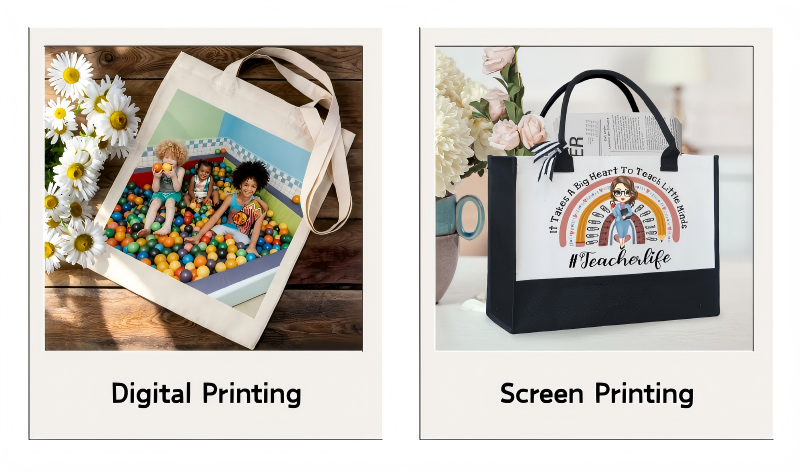
Digital Printing vs Screen Printing on Bags
Digitally-printed tote bags have the ability to reproduce smooth gradients as well as photo-quality details, making them particularly suitable for artistic or personalized designs. On the other hand, screen-printed totes often show strong, flat color areas with a higher level of texture, which is clearly seen as a mark of quality. Handbags and shopping bags behave in a similar way. In terms of backpacks, which are usually made from heavier canvas, both methods can be used successfully as long as the fabric composition is suitable.
Digital Printing vs Screen Printing on Apparel & Accessories
Screen-printed logos are common on coats and jackets due to the ink's high resistance to wear. For fresher, more detailed branding or custom text, aprons are well suited for digital prints. Pants with small logo prints are mostly screen printed, as screen ink usually demonstrates better resistance to friction and several washing cycles.
Digital Printing vs Screen Printing on Home & Decor
Digital printing is the undisputed champion when it comes to canvas paintings and prints. Photo-realistic images, watercolor effects, and subtle shading only render properly through digital ink. Home decor items with simple, bold patterns can go either way, depending on order volume.
Digital Printing on Cotton Canvas: Pros, Cons & Suitable For
Pros:
- Financially efficient even for one-off orders
- Production speed quite fast
- Highest quality photo reproductions
- Can produce single-item orders
- Changes color smoothly with no interruption of production
- Good for testing or sampling new products
- Environmentally friendly print process
- Lower prices for lighter fabrics with higher yields
Cons:
- Some fabrics cannot be printed on with this technology
- There is a 20% surcharge for printing on dark-colored fabrics
- Color fade and washout can occur after prolonged use
- It takes longer to produce large amounts
- It costs more to maintain the printer
Suitable for:
- Designers who want to test through print-on-demand the market
- Orders that are personalized, unique
- Small-batch runs
- Multi-color art pieces
- Samples or prototypes before production run
- Businesses that advertise their environmental friendliness
What Types of Designs Work Best With Digital Printing on Cotton Canvas?
| Design Type | Suitability | Notes |
|---|---|---|
| Photographic images | Excellent | Sharp detail, accurate color |
| Watercolor or gradient effects | Excellent | Smooth blending, no banding |
| Fine lines and small text | Good | Crisp edges at small sizes |
| Multi-color complex artwork | Excellent | No added cost per color |
| Illustration or hand-drawn styles | Excellent | Captures texture and shading |
| Large solid color blocks | Fair | Can look slightly uneven |
| Metallic or glitter effects | Poor | Not supported by inkjet ink |
| Bright colors on dark fabric | Fair | Needs a white base layer, raises cost |
Digital printing can reproduce fine details and gradations of color more accurately than any other technique when printing on cotton canvas today. Opting for it will give you the best results, especially if your artwork contains color fades, photographic elements, or is composed of more than four colors.
Screen Printing on Cotton Canvas: Pros, Cons & Best Use Cases
Pros:
- Produce bold and vibrant colors with high ink density
- Durable enough to withstand years of washing
- Extremely low cost per item for large runs
- Can use specialty inks like puff or metallic
- Perfectly match official brand colors using the Pantone system
- Compatible with a variety of textile materials
- Output is speedy once the screens are ready
- Produces a somewhat thick, textured feel
Cons:
- Expensive initial investment for screen preparation
- Minimum quantity requirement
- More complicated designs mean more costs; one screen per color
- Not very effective for producing smooth gradients
- More water consumption and chemical waste than digital alternatives
Suitable for:
- Mass production
- Simple brand logos or marks
- Designs intended for special ink effects
- Vibrant colored prints on dark garments
- Repeat, consistent restocking items
- Precise Pantone color matching
What Types of Designs Work Best With Screen Printing on Cotton Canvas?
Screen printing is more suitable for clear and bold designs rather than highly detailed ones:
- Single-color logos print sharply and cleanly
- Big and bold typography maintains its shape well
- Line drawings and sketches look sharp
- Highly saturated and bright colors stand out
- Photographs and subtle color changes hardly work
- Pantone brand colors can be perfectly matched
If your logo is made up of one to three flat color layers, then screen printing will deliver the most vivid and durable results.
Cost Comparison: Digital Printing on Fabric vs Screen Printing on Fabric
The biggest difference between the methods in terms of costs is the setup price.
- Digital printing: no setup fee, fixed price per unit, one-piece minimum
- Screen printing: $25 to $75 setup fee per color, unit price decreases with volume
- The breakeven point is somewhere between 50 and 75 pieces for a two-color design
- Digital printing costs less when you order fewer than 50 pieces
- Screen printing becomes the better choice at more than 75 pieces
- Screen printing wins without fail at more than 250 pieces
You should compare the figures before deciding on a method. Digitals are good for small orders, while bulk orders are better suited for screen printing.
DTG vs Silkscreen: Which One Should You Choose for Your Business?
More and more, sustainability is a key factor in consumer choice, and the two methods differ greatly in their impact.
- Digital printing is almost free of water usage and doesn't produce chemical waste.
- Screen printing consumes large volumes of water along with chemical emulsions and solvents.
- Digital printing operates on demand, so you don't generate dead stock
- Screen printing potentially leads to surplus production if orders don't get sold
- Digital printing represents the environmentally friendly option for the majority of POD and small-batch sellers
- In 2026, being eco-friendly through digital printing is not only a real claim but also one that can be challenged
If sustainability is one of the pillars of your brand, lean towards digital. If, however, lowering the cost per unit through larger batch production is your main focus, then screen printing may be the way to go.
What Are the Digital Alternatives for Cotton Printing?
DTG Printing
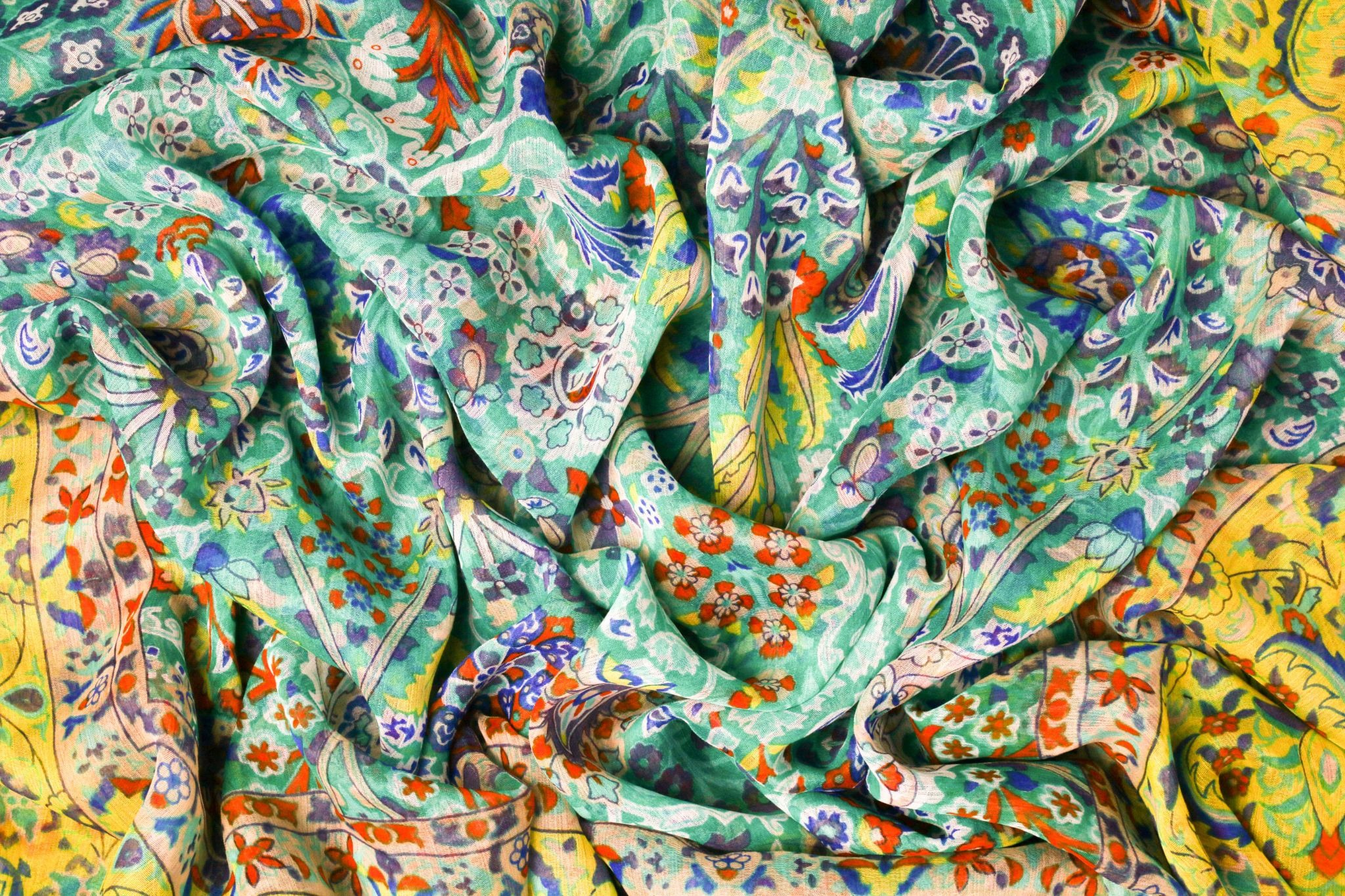
Printing directly onto a garment involves throwing tiny ink droplets onto the cloth. This method yields a very soft, natural-feeling, and breathable fabric, and it captures rich detail. It's quite okay for starting up or experimenting with a few items.
DTF Printing
Printing directly to the film involves the transfer of the design from a specially prepared film to the fabric with heat. This method supports a wider variety of fabrics than DTG and is also quite resistant to multiple washing cycles.
Sublimation Printing
In sublimation, ink is literally converted into a gas that bonds on a molecular level with the fibers. The biggest limitation of sublimation is that it can only work on polyester or polyester-coated items, not on 100% cotton. On the other hand, it is capable of producing bright, long-lasting colors on the compatible fabrics.
FAQ
Which printing method is better for a small business?
Digital is perfect for most small businesses - if you want demo versions of designs, you don't even have to make a minimum order, and the whole thing is risk-free since you pay only for the pieces you want to keep.
Is DTG printing good quality?
Yes, DTG can replicate even the tiniest elements and produces very truthful colors, especially when printed on white tops. The printed images tend not to last as long as those on screen-printed ones, which is why wearing and washing the item require some caution.
Which printing method is better for a sustainable business?
Digital printing is the one that easily fits a sustainable brand story since it uses less water and chemicals and also produces less waste, whereas screen printing is usually opposite in these aspects.
What type of fabric works best for digital printing?
A properly prepped cotton fabric with a tight and uniform weave shows the best results regarding digital ink absorption. Heavily textured or synthetic-heavy fabrics lead to reduced print quality.
Digital printing vs screen printing, which is more affordable?
Generally, it would depend on how many you order. If you want less than 50 pieces, go for digital because that is most cost-effective. For more than 75 pieces, screen printing will save you more money, and if you keep increasing the quantity, the price difference gets even bigger.
Which one is more durable, digital printing or screen printing?
Between screen printing and digital printing, screen printing generally tends to go on longer under heavy wash and wear conditions. However, for moderate use, digital printing can hold up well, but with repeated washing at high temperatures, it will fade faster.
Final Thoughts and Your Next Step
You should use both of these methods from time to time as they both give a chance to your production plan. Small orders are done in no time with digital printing - plus you get details and low risk. As soon as you reach a certain number, say hundreds, then screen printing would be the method that, with its durability and low cost, comes to your rescue. Don't let the order size and design dictate the method; rather, let the method align with your order size and design.
Why wait to witness these prints on genuine cotton canvas? Visit Inkedjoy.com and choose the printing method that suits your next order from the custom bag and art print collection.
Read more
- DTG vs Screen Printing: Which is Best for Print on Demand?
- Best Shirt Websites 2026: Quality Tees & Button-Downs Cheap
- Screen Printing vs Heat Press: Which Is Best for Your Business?
- 20 Best Dropshipping Clothing Suppliers (2026): Ranked by Profit, Speed & Reliability
- What is DTF Printing? The Ultimate Guide to Direct-to-Film
Written by
Gina
A skilled marketing specialist with expertise in e-commerce marketing, and print-on-demand product research. She has extensive experience in keyword research, market analysis, and content strategy, helping brands find uncover profitable opportunities, improve search visibility, and drive sustainable growth through data-driven marketing.