


Personalized, Long‑Lasting Water Bottles: Built to Endure with Custom Design
Personalized water bottles have moved from giveaway novelties to daily carry essentials that people depend on for hydration, health, and identity. For on‑demand printing and dropshipping businesses, this category blends everyday utility with brand storytelling, offering repeat visibility, premium gifting potential, and strong retention when the product survives real‑world use. As a senior e‑commerce entrepreneurship mentor who has guided hydration launches from first sample to scaled fulfillment, my goal in this playbook is to help you choose base bottles, materials, and printing methods that truly last, while protecting customer health and enhancing brand equity.
What “Long‑Lasting” Really Means in Drinkware
Longevity in drinkware is not just about dent resistance. The bottle needs to maintain structural integrity, preserve its finish and print after daily handling and cleanings, keep drinks at the right temperature for realistic periods, resist leaks during commute and travel, and support easy maintenance so customers actually keep using it. The lid and gasket system should remain serviceable, and replacement parts should be available. The design choices you make—especially around material, insulation type, and personalization—determine whether customers rave about your bottle a year from now or quietly replace it.
In practice, stainless steel with double‑wall vacuum insulation delivers the best mix of durability and temperature control for everyday carry, whereas borosilicate glass excels at taste purity at a desk. High‑quality BPA‑free plastics like modern Tritan are light and inexpensive, but they should be matched to use cases where insulation is unimportant and heat exposure can be minimized. Aluminum can be compelling for weight and cost in promotions but typically requires an internal liner and offers less insulation. Copper is sometimes marketed for antimicrobial properties but is not a fit for acidic or carbonated beverages, and it requires more careful care.
Definitions You Will See
BPA, BPS, and phthalates refer to families of plasticizers and related chemicals that can leach into beverages—many consumers prefer to avoid them. 18/8 stainless steel, also known as 304 stainless, is the common food‑grade alloy used in quality drinkware for corrosion resistance and reliability. Double‑wall vacuum insulation means two walls of steel separated by an airless gap, which slows heat transfer and keeps drinks cold or hot for many hours. Borosilicate glass is a more temperature‑resistant and durable glass than common soda‑lime glass and is favored in premium bottles with silicone sleeves. Tritan is a tough, BPA‑ and BPS‑free plastic used by reputable bottle brands. Leaching refers to chemicals migrating from a container into the drink; it increases with heat and time. PFAS, often called “forever chemicals,” are increasingly scrutinized across consumer products; some bottle makers emphasize PFAS‑free claims.
Materials That Endure and Keep Customers Safe
Safety and durability sit at the core of customer trust. Branch Basics highlights that containers should be free of heavy metals and plasticizers because even trace exposures matter over time, with the World Health Organization stating there is no known safe blood lead concentration and the CDC detailing risks to development and pregnancy. That is not abstract: stainless bottles can use lead during vacuum‑seal finishing; some advocates have shown that if a sealed logo button or pellet ever becomes exposed, it can present risk. Brands have responded with safer processes, including an alternative lead‑free sealing method pioneered by Hydro Flask in 2012. Meanwhile, “BPA‑free” plastics can still leach other chemicals, and more than fifty BPA alternatives exist; studies and consumer advocates advise ongoing caution, especially when heat is involved. If customers store bottles in hot cars or leave them in the sun, the potential for leaching rises.
Glass avoids these chemical concerns and does not retain flavors, though it is heavier and breakable. Stainless steel remains the workhorse for rugged use, and in field reviews and lab tests it stands out for insulation and durability, with outdoor testers frequently recommending specific lids and configurations for different scenarios. Aluminum is ultralight and budget‑friendly but typically relies on liners whose composition and scratch durability are not always transparent. Copper is antimicrobial by nature but unsuitable for acidic drinks and can impart taste; public health guidance about copper plumbing underscores the importance of careful use. Silicone collapsible bottles offer plastic‑free flexibility if they carry food‑grade labeling.
The following table summarizes material trade‑offs that matter in on‑demand customization.
Material | Safety Notes | Durability & Insulation | Weight & Handling | Print Compatibility | Best Use Cases |
|---|---|---|---|---|---|
18/8 stainless steel (304) | Food‑grade, non‑corrosive; verify lead‑free vacuum seal and BPA‑free lids per Branch Basics; PFAS‑free claims are emerging | Highest durability; double‑wall vacuum insulation commonly keeps drinks cold about 12–48 hours and hot about 6–12 hours per Crestline examples | Heavier than plastic; dents possible; great for daily carry and outdoors | Laser engraving and UV printing both work well; powder‑coat finishes protect prints; Allrecipes notes finishes like YETI resist chipping | Commuters, gym, outdoor, premium gifts |
Borosilicate glass | Inert and non‑leaching; pure taste; still confirm heavy‑metal testing as Branch Basics advises | No insulation unless paired with sleeves; protective silicone helps; fragile if dropped | Heavier; best when not jostled | Minimal engraving; decals can work; sleeves offer branding real estate | Desk, office, infusions, taste‑first buyers |
Tritan and other BPA‑/BPS‑free plastics | Light and durable; studies show plastics can still leach chemicals, especially with heat per Branch Basics | Non‑insulated; can scratch and retain odors over time | Lightest carry; ideal for hiking if weight is critical | Screen, pad, and UV printing are common; watch dishwasher heat | Promotions, budget events, ultralight hiking |
Aluminum | Requires interior liner; reputable makers use BPA‑free liners; composition can be unclear | Low dent resistance; poor heat retention vs. vacuum steel | Very light; dents easily | Screen, pad, and UV printing; durable wraps possible | Budget promotions, on‑the‑go events |
Copper | Antimicrobial but not for acidic or carbonated beverages; potential metallic taste | Single‑wall; not for hot drinks; requires care | Moderate weight | Engraving is striking; patina changes appearance | Traditional gifts, niche health‑minded buyers |
Silicone (collapsible) | Food‑grade silicone preferred; no BPA; avoid unverified “pinch tests” | Non‑insulated; flexible but less rigid | Ultra‑packable | Limited printing; sleeves or badges | Travel, back‑up carry |
Health and Safety: What Reputable Sources Advise
Branch Basics urges consumers to avoid heavy metals and plasticizers altogether and highlights that some stainless steel manufacturing steps can involve lead that must remain safely encapsulated. The World Health Organization and the CDC emphasize that there is no safe blood lead level, and long‑term, low‑dose exposures are linked to decreased intelligence in children, developmental and behavioral issues, and miscarriage risk. These positions are the baseline for your supplier checklist.
Plastic safety is more nuanced than “BPA‑free.” Branch Basics notes that many BPA alternatives behave as endocrine disruptors as well, and heat accelerates leaching. The safest route is minimizing heat exposure for plastic bottles and preferring glass or high‑grade stainless for hot or acidic liquids.
PFAS concerns are expanding across consumer goods. GearLab highlights PFAS‑free claims in products such as Klean Kanteen’s TKWide Recycled Insulated, which also scored highly in insulation. Although research into PFAS exposure pathways is ongoing, more consumers now seek PFAS‑free certification or claims, particularly for products that contact beverages.
Cornell University’s Waste Management Institute explains that U.S. municipal tap water is tightly regulated by the EPA, while bottled water is regulated by the FDA, with different testing frequencies and reporting requirements. The practical insight for brands is not to claim that bottled or filtered water is inherently safer; instead, educate customers about care, cleanliness, and proper filtration. Allrecipes’ bottle testing reminds us that filter bottles such as Brita reduce chlorine taste and particulates but do not remove bacteria, viruses, protozoa, or heavy metals; that distinction matters in your product pages.
Finally, cleaning is fundamental safety. BottlePro recommends washing after each use, deep cleaning every one to two weeks, and explicitly avoiding bleach on 304 stainless because it can corrode the metal. Wide mouths and simple parts make bottles easier to clean; designs that can go in the dishwasher reduce friction, though many premium finishes and lids remain hand‑wash only.
Insulation, Capacity, and Everyday Usability
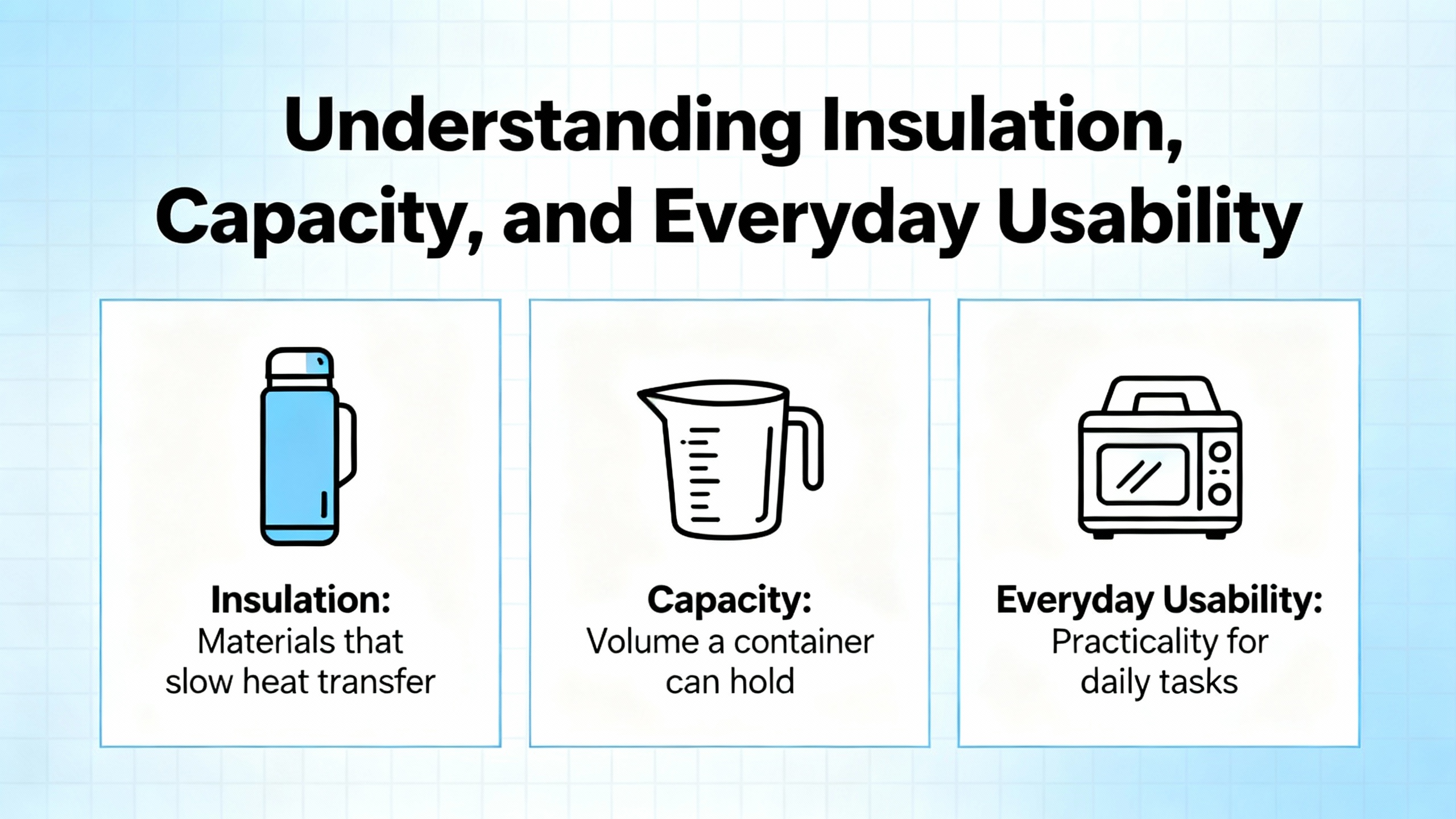
Double‑wall vacuum stainless construction is the benchmark for insulation. Crestline reports common performance ranges of about 12 to 48 hours cold and about 6 to 12 hours hot across typical models. In testing, reviewers frequently recommend stainless steel for outdoor use and glass for taste‑pure indoor sipping, with modern Tritan bottles providing excellent weight savings for hiking and backpacking. GearLab notes that glass bottles excel in taste but can heat up quickly in direct sun, reporting a 6‑hour sun test at 81°F ambient that raised water to 110°F in one glass model, reinforcing the importance of insulation for hot conditions.
Lid choice drives daily experience. Screw caps provide the most leak‑proof seal; straw lids enable tilt‑free sipping while driving or working out; chug lids provide high‑flow access; and sip lids work for hot beverages. Allrecipes’ testing highlights practical details like finish durability and cup‑holder fit, while BottlePro calls out the importance of cup‑holder adapters and wide bases for large bottles. As brands expand capacity into 40 or even 64 fl oz for all‑day hydration, the base diameter and handle ergonomics become decisive for customer satisfaction.
A simple capacity guide by persona helps customers self‑select quickly.
Persona or Use | Recommended Capacity | Key Considerations |
|---|---|---|
Kids and compact carry | 12–16 fl oz | Keep weight low; straw or push‑pull lids aid sipping; emphasize durability and dishwasher‑safe parts |
Commuters and gym goers | 20–24 fl oz | Cup‑holder compatibility and leak‑proof lids are critical; consider powder‑coat finishes for grip |
Outdoor day trips and hiking | 32 fl oz | Balance insulation with weight; add carry loops or straps; confirm lid parts are easy to clean away from home |
All‑day desk hydration | 40–64 fl oz | Large handles and straw lids encourage frequent sipping; accept limited portability and confirm base stability |
Personalization and Print Methods That Last
The value of a personalized bottle is only as strong as the permanence of its mark. Swagify points out that a single branded bottle can deliver more than 3,000 impressions over its life, and bulk costs can start around $5 per unit at volume. That ROI only materializes if the finish, print, and lid system survive real use. In practice, laser engraving on powder‑coated stainless steel is the most durable option because it etches the surface rather than adding an ink layer that can wear off. UV printing enables full‑color wraps with strong abrasion resistance on compatible coatings. Screen and pad printing remain cost‑efficient for logos and simpler art, especially on plastic or aluminum. Based on industry experience (moderate confidence), engraving tends to be the most durable, UV printing offers the best color breadth with high durability, and screen or pad printing are budget‑friendly for high‑volume promotions.
The table below outlines practical differences and use cases. Cost indications reflect typical industry patterns rather than a specific supplier’s pricelist (moderate confidence).
Method | Finish Look | Dishwasher Durability | Color Range | Typical Cost Impact | Best Fit |
|---|---|---|---|---|---|
Laser engraving on stainless | Crisp, permanent mark through powder coat to steel | Very high when base coating is quality | Single‑color metal tone | Medium | Premium gifts, longevity‑focused brands |
UV printing | Full‑color, photo‑capable with good abrasion resistance | High on compatible coatings; verify with supplier testing | Unlimited | Medium to high | Retail‑ready art, gradients, wrap designs |
Screen printing | Solid, opaque brand colors | Moderate; can fade with repeated dishwasher cycles | Limited spot colors | Low | High‑volume promos, budget events |
Pad printing | Precise logos on curves | Moderate; better on gentle curves | Limited spot colors | Low | Limited art on complex shapes |
Heat transfer | Vivid multi‑color on plastics and aluminum | Moderate; can lift at edges over time | High | Low to medium | Lightweight promotional bottles |
Dropshipping Setup That Reduces Returns
A resilient on‑demand pipeline starts with supplier vetting. Ask for heavy‑metal testing on glass and stainless components and for confirmation that no lead is used or that any lead used in vacuum‑seal finishing is completely encapsulated and never exposed; the Hydro Flask alternative seal introduced in 2012 is one example of a safer process, and Branch Basics urges this scrutiny. Confirm BPA‑ and BPS‑free claims for all plastic parts, including lid interiors and gaskets. If your buyers care, ask suppliers about PFAS‑free claims and any third‑party certifications mentioned by performance reviewers like GearLab.
Request pre‑production samples and test them as your customers will. A practical test plan that has served many brands includes a dyed‑water leak test left overnight, repeated dishwasher cycles for hand‑wash‑labeled finishes to understand failure modes, a fall test from waist‑height onto typical household surfaces, and lid interchange checks if you plan to sell accessory lids. BottlePro’s cleaning guidance suggests avoiding bleach on stainless steel; include that in your care card to prevent corrosion‑related returns. Where possible, choose lids with readily available replacement gaskets and straws.
Order logistics and packaging matter for dropshipping. Stainless bottles with powder‑coat finishes and high‑insulation walls tend to weigh more; check carrier dimensional weight and pack with scuff‑resistant sleeves or bags so the finish arrives pristine. A QR code inside the box that links to a cleaning and care micro‑guide reduces customer support tickets and extends product life.
From a market and ROI perspective, reusable bottles are poised for steady growth. Golmate, citing Grand View Research, places the global reusable water bottle market at more than $8 billion in 2022 with growth above 4% annually through 2030. Corkcicle’s analysis notes that the U.S. sold over 50 billion plastic bottles in 2022, with around 60 million discarded daily, reinforcing the sustainability story behind durable reusables. Swagify estimates the impression count and cost basis that make branded bottles a staple of onboarding kits, event giveaways, and retail merch.
Care Instructions to Include in Your Packaging
A bottle that is easy to care for will be used longer. Encourage customers to wash daily with warm soapy water and to deep clean weekly with cleaning tablets or a baking soda routine. Remind them to avoid bleach on stainless steel to prevent corrosion, per BottlePro. Suggest removing gaskets occasionally for a full clean, and make straw brushes available. For plastic bottles, advise against leaving them in hot cars or direct sunlight to minimize chemical migration, echoing Branch Basics’ caution that heat increases leaching risk. For filter bottles, explain clearly that carbon filters reduce chlorine and particulates but are not purifiers for biological contaminants; this aligns with testing summarized by Allrecipes. Clarity here prevents misuse and increases trust.
Buying Guide for Entrepreneurs: What to Specify and Verify
Your specification sheet should define the material grade (18/8 or 304 stainless; borosilicate glass; BPA‑/BPS‑free Tritan), the insulation type (double‑wall vacuum for temperature control), lid style and gasket materials, base diameter for cup‑holder fit, and print method with finish compatibility. Ask for third‑party lab tests confirming absence of lead on any accessible surfaces and for BPA‑/BPS‑free plastics, echoing Branch Basics’ checklist of “lead‑free, BPA/BPS‑free, no plastic lining inside caps” and “dishwasher‑safe, easy‑to‑clean design.” If your audience prioritizes PFAS‑free claims, request supporting documentation. Confirm dishwasher guidance and warranty terms, as some brands offer extended coverage while others limit defects coverage to a year or two. Ensure your supplier supports small‑batch runs for personalization, predictable lead times, and clear minimums that match your on‑demand volume.
Risks, Trade‑Offs, and Cons You Should Anticipate
No material is perfect in every situation. Glass is the safest from a chemical perspective and delivers pure taste but is fragile and heavier. Stainless steel is a daily‑carry champion but weighs more and costs more upfront; poorly made bottles can dent, and some finishes chip if mishandled. Plastics are light and affordable; even BPA‑free plastics can leach other chemicals, especially when heated, as Branch Basics cautions. Aluminum dents and depends on liners whose composition may be opaque to buyers. Copper bottles require more care and are best reserved for plain water, with public health guidance suggesting caution with hot or acidic liquids. Branch Basics also mentions that metallic materials can interact with electromagnetic fields; if your audience is sensitive to that discussion, glass remains a safe recommendation, while acknowledging that many consumers consider the practical risk minimal. Presenting these trade‑offs transparently in your product pages reduces surprises and returns.
Real‑World Configurations That Win
For daily commuters who value temperature control and a premium feel, a 20–24 fl oz double‑wall vacuum stainless bottle with a powder‑coat finish and laser‑engraved personalization delivers high durability with strong brand presence. For outdoor day trips, a 32 fl oz insulated stainless bottle with a chug lid and a protected UV‑printed wrap balances carry comfort and hydration volume. For office‑based taste purists, a 22 fl oz borosilicate glass bottle with a silicone sleeve and minimal tonal logo delivers clean flavor and an upscale aesthetic, provided you set expectations around fragility. For budget events and mass promotions where lightweight carry matters and insulation does not, a 20–25 fl oz Tritan bottle with a simple screw cap and screen‑printed logo meets the brief; pair it with clear care guidance to avoid heat exposure. These configurations align with findings from GearLab, Allrecipes, Crestline, and BottlePro about insulation performance, lid ergonomics, finish durability, and cleaning reality.
Takeaway
Personalized water bottles become powerful brand assets when they last through real life. Anchor your assortment with high‑grade 18/8 stainless steel for rugged, insulated daily carry; offer borosilicate glass for taste‑first customers; and deploy Tritan or aluminum strategically for budget or ultralight needs with clear care guidance. Select print methods that match the base finish—laser for permanence on powder‑coated steel, UV printing for durable full‑color, and screen or pad printing for high‑volume cost efficiency. Vet suppliers for heavy‑metal safety, BPA‑/BPS‑free plastics, and, where relevant, PFAS‑free claims. Include straightforward cleaning instructions and spare parts support. The market momentum toward reusables, the sustainability narrative, and the high impression count of branded bottles create a compelling business case; your edge comes from choosing a build and personalization approach that survives the dishwasher, the car cup holder, and the daily routine.
FAQ
How do I choose the right capacity for my audience?
Match the bottle to the daily journey. Many commuters prefer 20–24 fl oz for cup‑holder fit and carry comfort, while outdoor users step up to about 32 fl oz to reduce refills. Desk‑bound hydration or gym routines can justify 40–64 fl oz when portability matters less. This pattern aligns with capacity guidance summarized by Crestline, Cheeki, and field testing insights.
Are “BPA‑free” plastic bottles completely safe?
“BPA‑free” reduces one risk, but research cited by Branch Basics shows plastics can still leach other chemicals, particularly when heated. If you sell plastic bottles, encourage customers to avoid heat and to replace heavily scuffed bottles that can harbor odors. For hot or acidic drinks, prefer stainless steel or glass.
What certifications or claims should I request from suppliers?
Ask for third‑party heavy‑metal testing, BPA‑/BPS‑free documentation for any plastic parts, and, if your buyers care, PFAS‑free claims supported by material declarations. Branch Basics recommends lead‑free certification and no plastic lining inside caps. For stainless bottles, inquire specifically about the vacuum‑seal process and whether a lead‑free alternative is used.
Which print method lasts the longest on stainless steel?
Laser engraving is generally the most permanent on powder‑coated stainless because it etches into the surface rather than relying on an ink layer. UV printing is a close second when you need full color; modern coatings deliver strong abrasion resistance. This recommendation reflects practical industry experience and aligns with finish durability observations from consumer testing outlets like Allrecipes.
Do filter bottles make unsafe water safe to drink?
Most consumer carbon filter bottles reduce chlorine taste and some particulates but do not remove bacteria, viruses, protozoa, or heavy metals. Allrecipes’ test coverage underscores this limitation. For backcountry or questionable sources, customers need a purifier or an appropriate filtration system, not just a taste filter.
Is stainless steel better than glass for health?
Both can be excellent choices when manufactured properly. Glass is chemically inert and delivers the purest taste but is heavier and breakable. Stainless steel is durable and insulates well; ensure the product uses food‑grade 18/8 steel, that any vacuum‑seal process does not expose lead, and that lids and seals are made from safe materials. Branch Basics, WHO, and the CDC collectively point to avoiding heavy metals and plasticizers as the primary health priority.
References
- https://www.css.cornell.edu/cwmi/waterquality/bottled.htm
- https://www.hackensackmeridianhealth.org/en/healthu/2024/04/08/whats-the-healthiest-material-for-water-bottles
- https://www.bottlepro.net/hydration-blog/what-is-the-best-water-bottle-our-biggest-comparison-yet
- https://www.allrecipes.com/best-insulated-water-bottles-8406566
- https://crestline.com/c/custom-water-bottles-buying-guide
- https://destudiohome.com/what-to-look-for-when-buying-a-water-bottle/?srsltid=AfmBOopFQGyDQ6PoCH7-9GduGcwewOGnzvhguHT6lQQ6Io4idFSRD4br
- https://www.fayren.com/news/what-to-consider-when-designing-a-water-bottle
- https://golmate.com/top-10-custom-water-bottle-advantages/
- https://www.promoleaf.com/blog/the-complete-guide-to-custom-water-bottles?srsltid=AfmBOoqZRAC24YWBFMkpg81poJT627xfskgKUx7Z0zeHtwraKl8ICdZw
- https://waterbottleadvisor.com/best-water-bottles-materials/