How to Design Custom Jewelry with Inkedjoy
Key Takeaways
- Custom jewelry is a high-potential POD category: lightweight (low shipping costs), highly giftable (emotional purchasing), and high perceived value (healthy margins) – the global jewelry market is projected to hit $343.90 billion by 2032, with custom pieces driving growth.
- Inkedjoy eliminates traditional jewelry barriers: no design skills/craft training, no minimum order quantities (MOQ), no inventory costs – focus on design/marketing while the platform handles production, packing, and shipping.
- 6-step POD jewelry design process: Define audience → Select base products → Master design (300 DPI, bold elements, contrast) → Enable personalization (50-60% margins) → Build brand experience → Connect/launch on sales channels (Etsy/Shopify/WooCommerce).
Table of Contents
The global jewelry market is booming, expected to surpass $343.90 billion by 2032, and custom pieces are driving much of this growth. For print-on-demand (POD) sellers, this presents a golden opportunity—personalized jewelry commands higher prices, attracts gift-buyers year-round, and creates emotional connections that drive repeat business.
Unlike traditional jewelry design that requires metalworking skills and expensive equipment, POD platforms have democratized the process. With Inkedjoy, you can create professional-quality custom jewelry without touching a single tool or holding inventory. This guide walks you through the entire journey from concept to customer, blending proven design principles with platform-specific advantages.
Why Custom Jewelry Works for Print on Demand Sellers?
Before diving into the "how," let's address the "why." Custom jewelry succeeds in the print on demand model for three reasons: it's lightweight (low shipping costs), it's highly giftable (emotional purchasing decisions), and it carries perceived value that supports healthy margins. As Roman Jewelers notes, custom pieces become "heirlooms that hold meaning beyond trends or seasons"—exactly what modern consumers crave.
The beauty of working with a platform like Inkedjoy is the elimination of traditional barriers. No minimum order quantities, no upfront inventory costs, and no production logistics. You focus on design and marketing; Inkedjoy handles printing, packing, and shipping directly to your customers.

The Print-on-Demand Advantage
Traditional jewelry manufacturing demands significant barriers: technical training, supplier relationships, minimum order quantities, and capital tied up in unsold stock.
POD eliminates these obstacles. You design digitally, produce only what sells, and outsource fulfillment. This model shifts risk from inventory speculation to marketing execution—skills more entrepreneurs already possess.
How to Design Custom Jewelry in 6 Easy Steps
Step 1: Define Your Target Audience
Every successful jewelry line starts with clarity about who you're designing for. Without this foundation, even beautiful pieces can miss the mark. Ask yourself:
- Style preferences: Does your audience gravitate toward minimalist everyday wear or bold statement pieces?
- Life moments: Are you targeting brides-to-be, new mothers, pet parents, or long-distance couples?
- Values: Do they prioritize sustainability, affordability, or luxury materials?
- Purchase behavior: Do they shop on Etsy for handmade aesthetics, or prefer the convenience of Shopify stores?
Inkedjoy's catalog spans multiple jewelry types—from wooden earrings and photo projection bracelets to stainless steel necklaces and Spotify code bangles. Your audience research determines which products to prioritize. For instance, projection jewelry that hides photos inside pendants appeals heavily to romantic gift-givers, while engraved coordinate necklaces attract travel enthusiasts and memory-keepers.

Step 2: Select Your Canvas
With your audience defined, browse Inkedjoy's jewelry collection. The platform offers diverse base products including alloy photo necklaces starting around $3.33, wooden earrings at $4.29, and stainless steel pieces in various finishes. Each serves different design approaches and price points.
When selecting, consider the seasonality and occasion. Heart-shaped designs peak around Valentine's Day, while birthstone-adjacent pieces sell consistently year-round. Photo projection items work beautifully for anniversaries and Mother's Day, while minimalist engraved bracelets suit everyday wear and corporate gifting.
Pro tip: Review each product's specifications carefully. Note the printable areas, recommended file formats, and material properties. This information helps you set accurate customer expectations and avoid design mismatches.
Step 3: Master the Design Process
Here's where creativity meets technical execution. Inkedjoy provides a user-friendly design toolkit that supports both novice designers and experienced creators.
Uploading Your Artwork
For custom jewelry, high resolution is non-negotiable. Upload PNG, JPEG, or SVG files at 300 DPI minimum to ensure crisp printing and engraving. The platform's real-time preview feature lets you visualize exactly how your design will appear on the final product—crucial for small surfaces where every millimeter counts.
Leveraging Built-In Tools
Don't have a design background? Inkedjoy's toolkit includes:
- Text customization: Add names, dates, or quotes with various fonts, adjusting spacing and curves to fit pendant shapes
- Graphics library: Access ready-made elements optimized for jewelry engraving
- Bulk design capabilities: Create multiple product variations efficiently—ideal for testing different styles
Design Best Practices from the Pros
Fine details and thin lines often get lost in production, so prioritize bold, readable elements. A single well-placed initial often outperforms crowded compositions. For engravings, choose sturdy fonts over delicate scripts—what looks elegant on screen may blur when etched into metal.
Contrast is your friend. Dark designs on light metals (or vice versa) create visual impact. When using photos, ensure the main subject has clear definition against the background. Inkedjoy's projection jewelry, for example, works best with high-contrast images where the subject is recognizable even when miniaturized.
Step 4: Enable Personalization for Higher Margins
One of Inkedjoy's strongest features for jewelry sellers is the ability to offer customer-driven customization. Rather than selling static designs, you can create templates where buyers input their own photos, names, or special dates. To take that experience even further, pairing Inkedjoy with customily product personalizer turns your store into a true personalization powerhouse.
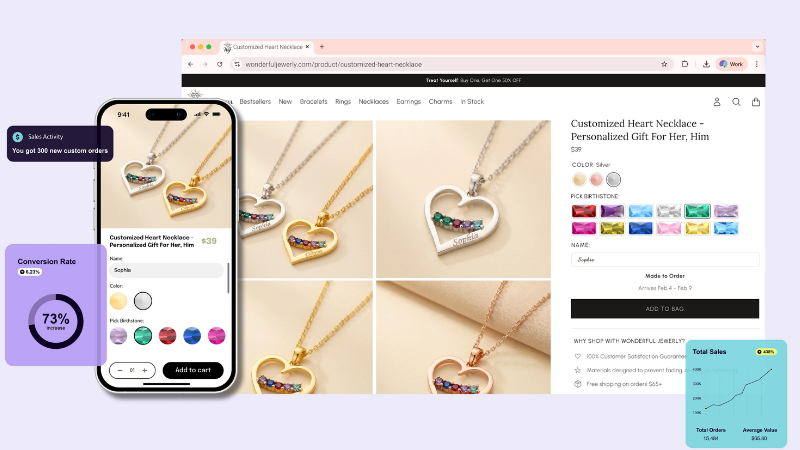
This personalization capability transforms a $15 necklace into a $40 keepsake. Customers pay premiums for items that feel exclusively theirs—whether that's a bracelet engraved with a child's handwriting, a projection pendant containing a wedding photo, or a Spotify code bangle linking to "their song."
What makes Customily especially valuable for jewelry sellers is that shoppers don't just describe what they want - they see it. Customily's real-time live preview lets customers type a name, upload a photo, or pick a font and instantly watch the design come to life on the product before they buy. That visual confidence is a proven conversion booster, and it dramatically reduces back-and-forth with customers after purchase.
Beyond the preview, Customily automatically generates print-ready files - whether you need engrave-ready vector files, laser-cut formats, or standard print files - and sends them directly to your fulfillment partner. No manual work, no errors.
Customily offers a 9-day free trial with full access to all features, no coding required, and you can be up and running in minutes.
To implement this effectively:
- Create clear mockups showing example customizations
- Provide detailed instructions for photo uploads (resolution requirements, cropping guides)
- Use Customily's Design Studio to build jewelry templates with locked boundaries, so customers personalize within your parameters, and every output looks professional.
- Set realistic production expectations—custom pieces may add a day or two to fulfillment
- Price strategically: personalized items typically support 50-60% margins versus 40% for standard designs, and Customily even lets you add automatic price surcharges for personalization options to protect those margins
Step 5: Build Your Brand Experience
Jewelry is emotional commerce. The unboxing experience matters as much as the product itself. Inkedjoy supports white-label branding including custom labels, hangtags, packing bags, and gift cards—essential for creating that premium feel that justifies higher prices.
Consider the entire customer journey:
- Packaging: Jewelry often ships in gift-ready boxes; ensure your branding extends to these touchpoints
- Care instructions: Include printed guides for maintaining engraved or printed pieces
- Gift messaging: Offer complimentary gift notes during checkout—crucial for the gifting market
Roman Jewelers emphasizes that craftsmanship extends beyond the piece itself to "the interpersonal qualities required for a productive cooperation." In POD terms, this translates to consistent quality, reliable shipping (Inkedjoy offers 30-day delivery guarantees with full refunds for delays), and responsive customer service.

Step 6: Connect and Launch
With designs finalized, connect your Inkedjoy account to your sales channels. The platform integrates seamlessly with Etsy, Shopify, and WooCommerce—allowing one-click product import and automatic order synchronization.
For marketplace sellers, optimize your listings with:
- Lifestyle photography: Use Inkedjoy's mockup generator to show pieces being worn
- SEO-rich titles: Include material types, customization options, and occasion keywords
- Story-driven descriptions: Explain the emotional value—who this gift is for and why it matters
- Social proof: Once sales begin, showcase customer photos (with permission) to build trust
Advanced Tips for Jewelry Sellers
- Test with samples: Order production samples before scaling. Evaluate the engraving depth, print clarity, chain quality, and packaging. This firsthand experience enables accurate product descriptions and confident customer service.
- Create collections: Group complementary pieces—matching necklace and earring sets, or "mother-daughter" bracelet pairs. Inkedjoy's bulk design tools make creating cohesive collections efficient.
- Monitor trends: Projection jewelry, coordinate engraving, and Morse code bracelets trend cyclically. Stay agile, using Inkedjoy's no-MOQ model to test trending designs without inventory risk.
- Price for perceived value: Jewelry pricing follows emotional logic more than cost-plus formulas. A $6 base cost can support a $25-35 retail price when marketed as a meaningful keepsake.
Conclusion: Your Jewelry Empire Awaits
Designing custom jewelry with Inkedjoy removes every traditional barrier to entry—no craft skills required, no inventory to manage, no minimum orders to meet. By combining the platform's technical capabilities with thoughtful audience targeting, clean design principles, and strategic personalization, you can build a profitable jewelry line that resonates with customers seeking meaningful, wearable art.
The process is straightforward: define your niche, select appropriate base products, design with simplicity and contrast in mind, enable customization for premium pricing, and brand the entire experience. Whether you're drawn to the romantic appeal of photo projection pieces, the natural aesthetic of wooden earrings, or the sleek modernity of engraved steel, Inkedjoy provides the canvas—you bring the creativity.
Start with one design. Test it. Refine it. Scale what works. In the $549 billion jewelry market, there's room for your unique vision.
FAQ
Do I need design experience to create custom jewelry?
No. Inkedjoy's platform is built for entrepreneurs, not professional designers. The built-in toolkit allows you to upload images, add text, and adjust layouts without any graphic design background.
What file formats work best for jewelry designs?
Upload PNG or JPEG files for photographic images, ensuring 300 DPI resolution minimum. For logos, text, or line art, SVG vector files provide the sharpest results. The platform accepts files up to specific size limits, so check product specifications before uploading complex artwork.
What is the 2:1:1 rule for jewelry?
The 2-1-1 rule is a styling guideline for balanced jewelry wearing: two subtle pieces, one medium-impact piece, and one statement item. For example, wear two delicate rings, a simple bracelet, and bold earrings together. This creates a cohesive, intentional look without appearing overdone.
What program is used to design jewelry?
Traditional jewelers use expensive CAD software requiring technical training. For POD sellers, Inkedjoy's built-in Product Creator toolkit handles everything—upload images, add text, adjust layouts, and preview designs in real-time, all within your browser without downloading any software.
Read More from Inkedjoy Blog
Written By Suey
Suey is a fashion-focused SEO writer with expertise in print-on-demand. She creates practical, trend-driven content covering custom apparel, design inspiration, and print on demand best practices, helping sellers and brands navigate the competitive eCommerce landscape.