
How to Go Viral on Facebook: 5 Practical Strategies in 2026

How to Go Viral on Facebook: 5 Practical Strategies in 2026

Oct 13, 2026 by Gina POD e-Commerce 101

Updated for 2026 | Fact-checked by Ecommerce Sourcing Team | 12-Min Read


Key Takeaways

  • A Facebook post is likely going viral when its reach is at least 5 times your usual reach, but views alone don't tell the whole story.
  • Shareable content gives people a reason to pass it along, and the strongest hooks work within the first 3 seconds.
  • There is no single best posting time, so test your own peak slots instead of following one study as a rule.
  • Reels, Groups, and Collabs help you reach beyond your existing followers when your content fits the audience.
  • After a post goes viral, publish two follow-ups within 72 hours and turn the attention into a long-term audience.

Have you ever had a Facebook post take off unexpectedly? The views and shares start rolling in, and you wonder what made it work—and whether you can do it again.

Going viral on Facebook often starts with a post that resonates with people. Maybe the topic catches their attention, the message feels familiar, or they see something worth sharing with friends.

In this guide, you'll learn how to spot a viral post, create content people want to share, reach more of the right audience, and turn that attention into potential sales.

How Can You Tell If a Facebook Post Has Gone Viral?

A Facebook post may be going viral when its reach is at least 5 times your usual reach, especially if shares and comments are climbing with it. However, the numbers alone don't tell the whole story. An outfit video for a niche audience that gets 800+ views could bring in as many orders as a household product unboxing video with 5,000+ views if it reaches people who are more likely to buy.

A simple way to start: look at how your post's reach stacks up against the median of your last 30 posts. The median makes a better baseline than the average, since a single overachiever or underperformer can skew an average.

Viral Multiplier = Post Reach ÷ Median Reach of Your Last 30 Posts

For example, if you normally reach about 500 people and a new post suddenly reaches 5,000, that's a 10× multiplier. Just treat these ranges as loose benchmarks, not something Facebook officially defines.

Viral Multiplier Working Label
5 to less than 10× Mini viral
10 to less than 20× Breakout
20× or more Exceptional

What Are 5 Practical Ways to Go Viral on Facebook in 2026?

The core of going viral on Facebook is giving people a reason to stop, engage and share, then getting the post in front of the right audience. What's more, they actually want to buy from you.

Here are five practical ways to make it easier for you to go viral on Facebook.

1. Make Posts People Want to Share

Before publishing a post, ask yourself one question: Would someone want to send this to a friend or share it with someone who relates to it? If the answer is no, the idea may need more work before you post it.

Shareable content gives people a reason to pass a post along, potentially exposing it to audiences beyond your existing followers. Common reasons people share content include:

  • Humor: Something that makes people laugh
  • Useful information: A tip, recommendation, or idea that someone would want a friend to see.
  • Shared Identity: Content that reflects people's hobbies, professions, lifestyles, or communities.
  • Strong emotions: Something that sparks surprise, happiness, nostalgia, or even frustration.
  • Relatable experiences: Everyday situations that make people think, "That's exactly me."

For example, a T-shirt seller could post a Monday-morning joke that resonates with people who dread the start of the workweek.

Once you find an angle that actually resonates and gets results, don't just jump to a completely different idea. Instead, milk it a little: try the same concept with different designs, examples, or opening lines, and see how far you can take a winning idea rather than starting from scratch every time.

2. Hook Viewers in the First 3 Seconds

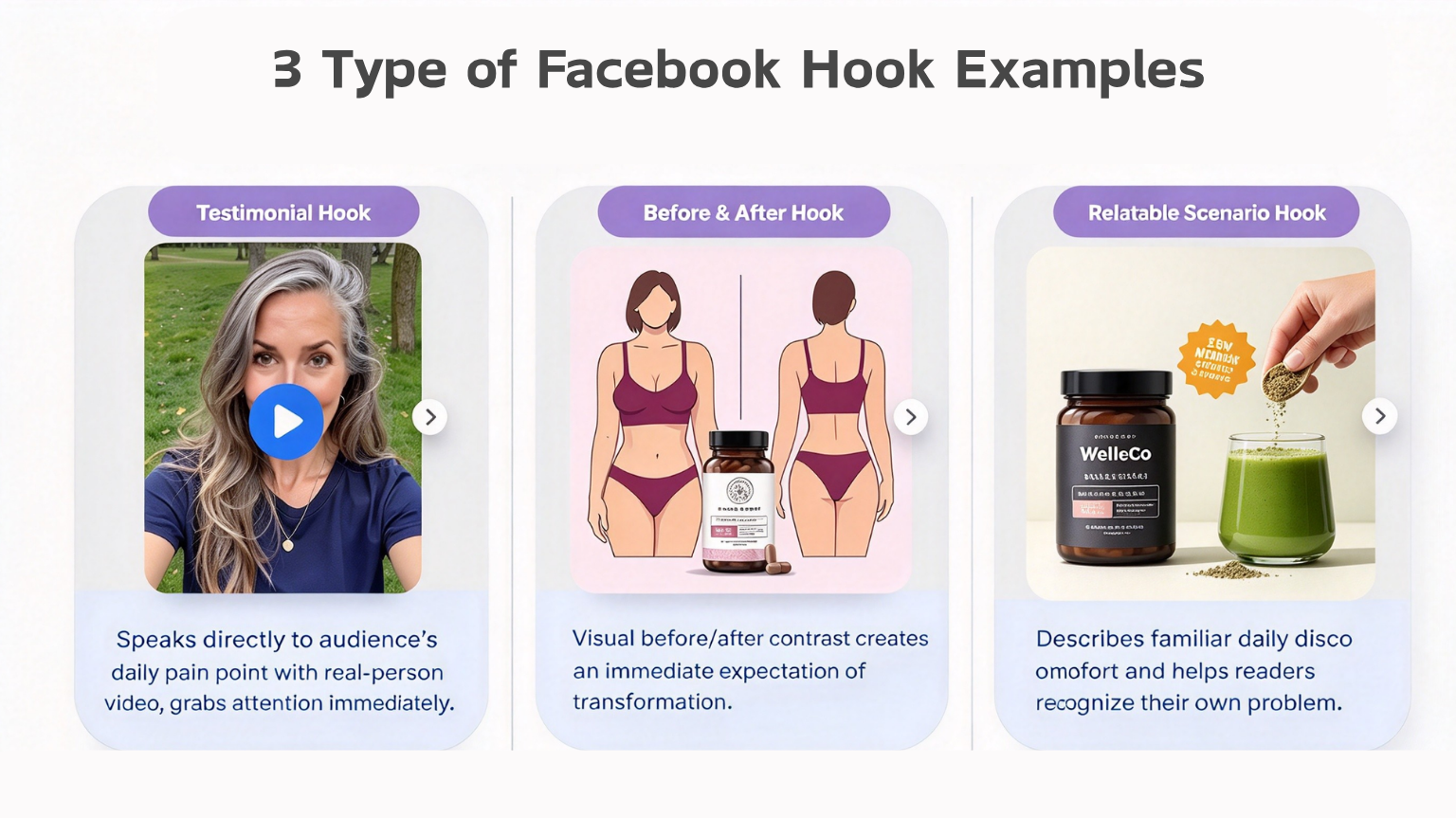
Get straight to the point by opening with a question your audience cares about, a problem they recognize, or a result they want to see, rather than making them sit through a long introduction. If you're unsure which approach will work best, try at least three different openings for the same video and compare them to see which one gives viewers the strongest reason to keep watching.

You can pick from these hook types:

  • Curiosity gap: "Nobody tells you this about..."
  • Contrarian: "Stop doing X if you want Y."
  • Problem: "If your Facebook posts keep getting ignored..."
  • Fear of missing out (FOMO): "Most sellers are missing this..."
  • Visual hook: Show the result or problem first.
  • Specific number: "3 changes that can..."
3. Post at Your Audience's Most Active Times

When you publish can affect how easily your audience sees and responds to your content, but there's no single perfect posting time that works for every Facebook Page. Sprout Social's 2026 study points to Tuesday and Wednesday, 12 p.m. to 8 p.m., while Buffer's analysis of 14 million Facebook posts names Thursday at 9 a.m. as its top slot. The two studies don't agree, so treat their findings as a starting point to test rather than a rule your audience will follow.

To find your own peak times:

  • Check your audience activity: Open Meta Business Suite and look at the active times it shows for your Page, if available, and use that as a starting point.
  • Review your past posts: Sort your recent posts by day and time to see which got the strongest reach and engagement, keeping Reels, images, and link posts separate so the comparison stays fair.
  • Test different time slots: Pick two or three promising slots and post similar content in each over a few weeks so you can see what actually performs.
  • Keep the time slots that work: Compare the results, keep the slots that consistently do better, and repeat the test every so often to stay aligned with your audience.

4. Use Polls and Stickers to Spark More Comments

Give people an easy, specific way to join in instead of asking something broad like "What do you think?" A print-on-demand (POD) seller, for example, could post "Which design would you wear: A or B?" as a poll, or use a poll sticker in a Reel if it's available for your account.
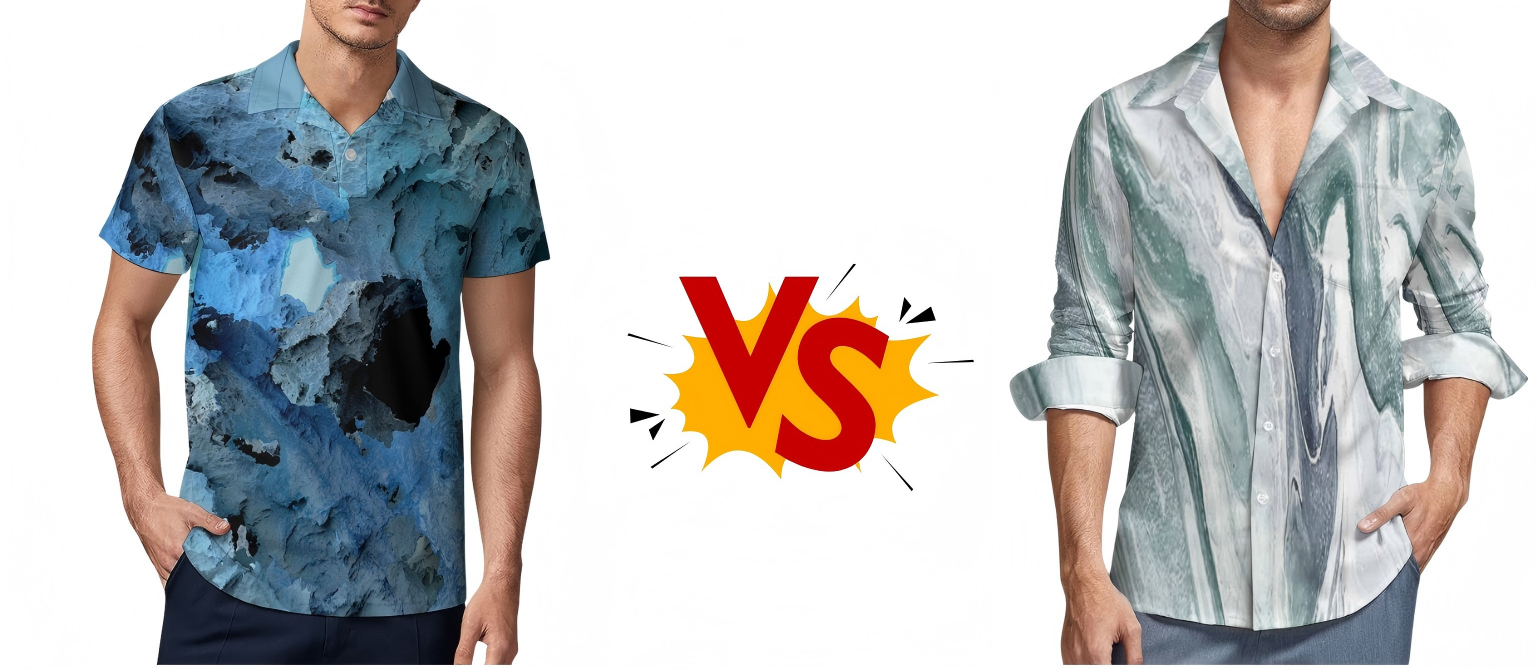
Which design would you wear: A or B?

Then follow up on the results. Share the winning design in a new post, ask voters why they chose it, and invite them to suggest a color or variation. That gives you a second round of traffic, and it shows you what people actually want to buy.

If a design gets people interested, you can take the next step without committing to a large inventory order. Print on demand lets you turn promising designs into products with relatively low upfront costs, making it easier to see whether that interest translates into actual purchases.

5. Reach New Audiences Through Reels, Groups, and Collabs

If you want to reach beyond your existing followers, you need to get your content in front of people who'll actually care about it. Here are three approaches to try:

Reels — Get Discovered by Non-Followers

Show the most interesting part in the opening seconds, add on-screen text, and demonstrate something worth watching. For example, a POD seller could show a plain T-shirt transforming into a finished custom design.

Facebook Groups — Reach People Already in Your Niche

Join communities where your target customers discuss their interests. Answer questions, share useful ideas, and follow each group's promotion rules instead of repeatedly dropping product links.

Facebook Collabs — Tap Into Another Creator's Audience

Find creators whose audiences overlap with yours and try a co-created Reel, a joint post, or a content swap. A seller of hobby-themed apparel, for instance, could work with a creator in that hobby to showcase a design in context.

If a post takes off, demand for a featured design may rise quickly. With print on demand, products are made as orders come in, so you don't have to stock large quantities in advance. You still need to check production capacity and shipping times to make sure customers know what to expect.

Set Up Your Store Before You Go Viral

For print-on-demand and e-commerce sellers, viral traffic is a double-edged sword. If your store can't handle the surge, that traffic is wasted. A visitor who can't find a price or a size leaves in seconds.

Before promoting your products, check that:

  • Product pages are live and easy to navigate.
  • Product photos are clear and sizing information is available.
  • Prices and shipping information are easy to find.
  • Calls to action are clear.
  • Mobile checkout works smoothly.
  • Return policies are visible.
  • Your Page has a pinned post explaining what you sell.
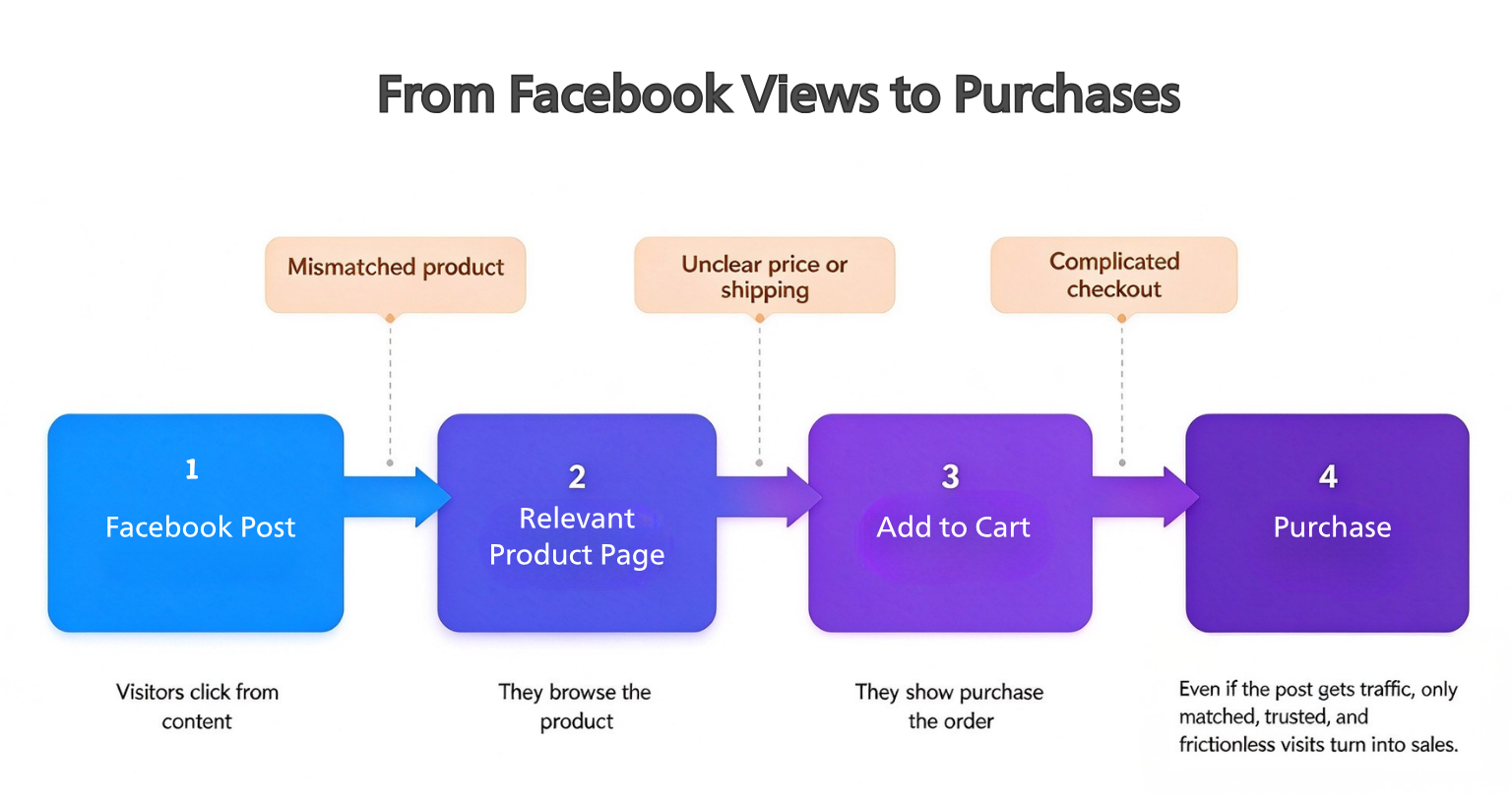
Turn Facebook Viral Traffic Into Sales

What Should You Do After a Facebook Post Goes Viral?

Look beyond views to see what worked, then publish two follow-up posts within 72 hours while people are still talking about the topic.

A high view count doesn't always mean a post resonated with its audience. To see why views alone can't tell the whole story, let's compare two hypothetical Facebook Reels:

Metric Reel A: High Views Reel B: Stronger Engagement
Views 50,000 8,000
Reach 40,000 6,500
Shares 100 160
Share rate 0.25% 2.46%
Comments 50 65
Comment rate 0.13% 1%

Reel A attracted far more views, but Reel B generated more shares and comments despite reaching a much smaller audience. So if you want to understand what made a post stand out, don't stop at views. There are two moves: first, unpack what the post did right, then check the data to see how people actually responded.

Step 1: Unpack what the post did right

Ask yourself these questions:

  • Topic: Did the subject address a common interest, problem, or curiosity?
  • Hook: What made people stop scrolling?
  • Format: Did the Reel, image, or text post best deliver the message?
  • Emotional angle: Did it make people laugh, feel understood, or feel surprised?
  • Audience: Which viewers reacted most strongly?
  • Timing: Did the publishing time coincide with stronger audience activity?
  • Share trigger: What gave people a reason to share the post?
  • Content-product fit: If a product was featured, did it fit naturally into the content?

Step 2: Check the data to see how people responded

  • Shares and comments: Find out what people think about your content.
  • Watch time and viewer retention: Check the retention graph, if available, to see where viewers dropped off and which parts held their attention.
  • Saves: If this metric is available, check whether people saved the post to revisit later.

Create 2 Follow-Ups Within 72 Hours

When a Facebook post takes off, don't just watch it climb. You've got a short window, roughly the next 72 hours, while people are still talking about the topic. That's your chance to test two related follow-up posts.

Post 1: Explore a related angle. Answer a popular question from the comments, dig into a related problem, or share a useful next step. The goal is to go deeper on the same idea, not repeat it.

Post 2: Try a different format. Take the original idea and turn it into a Reel, an image post, or a short text post. Same message, new packaging, and a chance to see how your audience responds to each format.

A word of caution: don't just repost the same content with minor tweaks. That teaches you nothing. Give each post a distinct angle, then check its reach, shares, and comments against your usual results.

Turn Viral Reach Into a Long-Term Audience

When a viral post brings new people to you, give them a reason to stay connected. Point them to a destination where you can keep sharing useful content and introduce relevant offers over time, such as:

  • Drive Traffic to Your Website: Link to a relevant product collection, blog post, or brand story to encourage visitors to explore more.
  • Collect Email Subscribers: Offer a discount code for first-time buyers in exchange for signing up for marketing emails.
  • Build a Community: Invite viewers to join a Facebook Group where they can exchange ideas and interact with your brand beyond promotional posts.

Why Is Your Facebook Reach So Low?

Low reach usually comes from a weak opening, little reason to engage, limited discovery, engagement bait or too much promotion. It's easy to blame the algorithm instead, but the cause is often in the post itself. Before you decide, compare the post with your usual reach, then use the table below to match what you see to the likely cause.

Diagnose and Fix Low Reach

What you see Likely cause What to do next
High views, low watch time; viewers scroll past quickly Weak opening or slow pacing Lead with a relatable problem, an intriguing question, or the most interesting moment
Viewers watch but do not react, comment, or share No strong reason to engage Add a relatable topic, a useful tip, or a direct question
Engagement is reasonable but reach stays limited Limited audience discovery Test Reels, collaborate with relevant creators, or share in niche communities
Reach drops after posts that push people to react Engagement bait Replace the prompt with a real question or a useful reason to comment
Reach stays low when most of your posts are promotional Too much promotion, little value for viewers Mix in posts that entertain or help, and promote less often

Avoid engagement bait, such as "Comment YES if you agree." These prompts ask for reactions without giving viewers anything in return, and Meta discourages them, so posts that rely on them may reach fewer people.

Conclusion

A viral post is much easier to repeat once you understand why it worked. Use your own reach as the baseline, look at what made people stop, react, and share, and build your next post around that insight.

Plan to sell your design on Facebook? Put this into practice with your next post, then let Inkedjoy handle the rest.

Explore Inkedjoy's POD Collection →


Frequently Asked Questions

How many views do you need to go viral on Facebook?

A Facebook post reaching 10,000 views in a day may be considered viral for a small Page, especially if that far exceeds its usual performance.

How long does it take for a Facebook post to go viral?

There's no fixed timeline. Some posts take off within hours, while others build over a few days as people keep sharing them. Compare the post's reach with your usual reach after a day or two before you judge how it's doing.

Are Facebook reels more likely to go viral than regular posts?

Not necessarily. Reels can be shown to people who don't follow you, which gives them more room to spread, but a strong idea can take off in any format.

Can you go viral on Facebook without paying for Ads?

Yes. You can reach new audiences through organic content without paying to promote it. Shareable posts, engaging Reels, and relevant community participation can help expand your reach, although results vary by content and audience.

What's the best time to post on Facebook to go viral?

Check your Page's audience activity and past post performance, then test different posting windows to find what works for your followers.

Does going viral on Facebook mean more sales?

No. A viral Facebook post can increase exposure, but it does not guarantee more sales—it pays off only when viewers are likely buyers, your store is ready for the traffic, and the post gives one clear next step. Track clicks and orders, not just views.

Read More

G

Written by

Gina

A skilled marketing specialist with expertise in e-commerce marketing, and print-on-demand product research. She has extensive experience in keyword research, market analysis, and content strategy, helping brands find uncover profitable dropshipping opportunities, improve search visibility, and drive sustainable growth through data-driven marketing.
 

Like the article

0
How to Go Viral on Facebook: 5 Practical Strategies in 2026

How to Go Viral on Facebook: 5 Practical Strategies in 2026

Updated for 2026 | Fact-checked by Ecommerce Sourcing Team | 12-Min Read


Key Takeaways

  • A Facebook post is likely going viral when its reach is at least 5 times your usual reach, but views alone don't tell the whole story.
  • Shareable content gives people a reason to pass it along, and the strongest hooks work within the first 3 seconds.
  • There is no single best posting time, so test your own peak slots instead of following one study as a rule.
  • Reels, Groups, and Collabs help you reach beyond your existing followers when your content fits the audience.
  • After a post goes viral, publish two follow-ups within 72 hours and turn the attention into a long-term audience.

Have you ever had a Facebook post take off unexpectedly? The views and shares start rolling in, and you wonder what made it work—and whether you can do it again.

Going viral on Facebook often starts with a post that resonates with people. Maybe the topic catches their attention, the message feels familiar, or they see something worth sharing with friends.

In this guide, you'll learn how to spot a viral post, create content people want to share, reach more of the right audience, and turn that attention into potential sales.

How Can You Tell If a Facebook Post Has Gone Viral?

A Facebook post may be going viral when its reach is at least 5 times your usual reach, especially if shares and comments are climbing with it. However, the numbers alone don't tell the whole story. An outfit video for a niche audience that gets 800+ views could bring in as many orders as a household product unboxing video with 5,000+ views if it reaches people who are more likely to buy.

A simple way to start: look at how your post's reach stacks up against the median of your last 30 posts. The median makes a better baseline than the average, since a single overachiever or underperformer can skew an average.

Viral Multiplier = Post Reach ÷ Median Reach of Your Last 30 Posts

For example, if you normally reach about 500 people and a new post suddenly reaches 5,000, that's a 10× multiplier. Just treat these ranges as loose benchmarks, not something Facebook officially defines.

Viral Multiplier Working Label
5 to less than 10× Mini viral
10 to less than 20× Breakout
20× or more Exceptional

What Are 5 Practical Ways to Go Viral on Facebook in 2026?

The core of going viral on Facebook is giving people a reason to stop, engage and share, then getting the post in front of the right audience. What's more, they actually want to buy from you.

Here are five practical ways to make it easier for you to go viral on Facebook.

1. Make Posts People Want to Share

Before publishing a post, ask yourself one question: Would someone want to send this to a friend or share it with someone who relates to it? If the answer is no, the idea may need more work before you post it.

Shareable content gives people a reason to pass a post along, potentially exposing it to audiences beyond your existing followers. Common reasons people share content include:

  • Humor: Something that makes people laugh
  • Useful information: A tip, recommendation, or idea that someone would want a friend to see.
  • Shared Identity: Content that reflects people's hobbies, professions, lifestyles, or communities.
  • Strong emotions: Something that sparks surprise, happiness, nostalgia, or even frustration.
  • Relatable experiences: Everyday situations that make people think, "That's exactly me."

For example, a T-shirt seller could post a Monday-morning joke that resonates with people who dread the start of the workweek.

Once you find an angle that actually resonates and gets results, don't just jump to a completely different idea. Instead, milk it a little: try the same concept with different designs, examples, or opening lines, and see how far you can take a winning idea rather than starting from scratch every time.

2. Hook Viewers in the First 3 Seconds

Get straight to the point by opening with a question your audience cares about, a problem they recognize, or a result they want to see, rather than making them sit through a long introduction. If you're unsure which approach will work best, try at least three different openings for the same video and compare them to see which one gives viewers the strongest reason to keep watching.

You can pick from these hook types:

  • Curiosity gap: "Nobody tells you this about..."
  • Contrarian: "Stop doing X if you want Y."
  • Problem: "If your Facebook posts keep getting ignored..."
  • Fear of missing out (FOMO): "Most sellers are missing this..."
  • Visual hook: Show the result or problem first.
  • Specific number: "3 changes that can..."

3. Post at Your Audience's Most Active Times

When you publish can affect how easily your audience sees and responds to your content, but there's no single perfect posting time that works for every Facebook Page. Sprout Social's 2026 study points to Tuesday and Wednesday, 12 p.m. to 8 p.m., while Buffer's analysis of 14 million Facebook posts names Thursday at 9 a.m. as its top slot. The two studies don't agree, so treat their findings as a starting point to test rather than a rule your audience will follow.

To find your own peak times:

  • Check your audience activity: Open Meta Business Suite and look at the active times it shows for your Page, if available, and use that as a starting point.
  • Review your past posts: Sort your recent posts by day and time to see which got the strongest reach and engagement, keeping Reels, images, and link posts separate so the comparison stays fair.
  • Test different time slots: Pick two or three promising slots and post similar content in each over a few weeks so you can see what actually performs.
  • Keep the time slots that work: Compare the results, keep the slots that consistently do better, and repeat the test every so often to stay aligned with your audience.

4. Use Polls and Stickers to Spark More Comments

Give people an easy, specific way to join in instead of asking something broad like "What do you think?" A print-on-demand (POD) seller, for example, could post "Which design would you wear: A or B?" as a poll, or use a poll sticker in a Reel if it's available for your account.

Which design would you wear: A or B?

Then follow up on the results. Share the winning design in a new post, ask voters why they chose it, and invite them to suggest a color or variation. That gives you a second round of traffic, and it shows you what people actually want to buy.

If a design gets people interested, you can take the next step without committing to a large inventory order. Print on demand lets you turn promising designs into products with relatively low upfront costs, making it easier to see whether that interest translates into actual purchases.

5. Reach New Audiences Through Reels, Groups, and Collabs

If you want to reach beyond your existing followers, you need to get your content in front of people who'll actually care about it. Here are three approaches to try:

Reels — Get Discovered by Non-Followers

Show the most interesting part in the opening seconds, add on-screen text, and demonstrate something worth watching. For example, a POD seller could show a plain T-shirt transforming into a finished custom design.

Facebook Groups — Reach People Already in Your Niche

Join communities where your target customers discuss their interests. Answer questions, share useful ideas, and follow each group's promotion rules instead of repeatedly dropping product links.

Facebook Collabs — Tap Into Another Creator's Audience

Find creators whose audiences overlap with yours and try a co-created Reel, a joint post, or a content swap. A seller of hobby-themed apparel, for instance, could work with a creator in that hobby to showcase a design in context.

If a post takes off, demand for a featured design may rise quickly. With print on demand, products are made as orders come in, so you don't have to stock large quantities in advance. You still need to check production capacity and shipping times to make sure customers know what to expect.

Set Up Your Store Before You Go Viral

For print-on-demand and e-commerce sellers, viral traffic is a double-edged sword. If your store can't handle the surge, that traffic is wasted. A visitor who can't find a price or a size leaves in seconds.

Before promoting your products, check that:

  • Product pages are live and easy to navigate.
  • Product photos are clear and sizing information is available.
  • Prices and shipping information are easy to find.
  • Calls to action are clear.
  • Mobile checkout works smoothly.
  • Return policies are visible.
  • Your Page has a pinned post explaining what you sell.

Turn Facebook Viral Traffic Into Sales

What Should You Do After a Facebook Post Goes Viral?

Look beyond views to see what worked, then publish two follow-up posts within 72 hours while people are still talking about the topic.

A high view count doesn't always mean a post resonated with its audience. To see why views alone can't tell the whole story, let's compare two hypothetical Facebook Reels:

Metric Reel A: High Views Reel B: Stronger Engagement
Views 50,000 8,000
Reach 40,000 6,500
Shares 100 160
Share rate 0.25% 2.46%
Comments 50 65
Comment rate 0.13% 1%

Reel A attracted far more views, but Reel B generated more shares and comments despite reaching a much smaller audience. So if you want to understand what made a post stand out, don't stop at views. There are two moves: first, unpack what the post did right, then check the data to see how people actually responded.

Step 1: Unpack what the post did right

Ask yourself these questions:

  • Topic: Did the subject address a common interest, problem, or curiosity?
  • Hook: What made people stop scrolling?
  • Format: Did the Reel, image, or text post best deliver the message?
  • Emotional angle: Did it make people laugh, feel understood, or feel surprised?
  • Audience: Which viewers reacted most strongly?
  • Timing: Did the publishing time coincide with stronger audience activity?
  • Share trigger: What gave people a reason to share the post?
  • Content-product fit: If a product was featured, did it fit naturally into the content?

Step 2: Check the data to see how people responded

  • Shares and comments: Find out what people think about your content.
  • Watch time and viewer retention: Check the retention graph, if available, to see where viewers dropped off and which parts held their attention.
  • Saves: If this metric is available, check whether people saved the post to revisit later.

Create 2 Follow-Ups Within 72 Hours

When a Facebook post takes off, don't just watch it climb. You've got a short window, roughly the next 72 hours, while people are still talking about the topic. That's your chance to test two related follow-up posts.

Post 1: Explore a related angle. Answer a popular question from the comments, dig into a related problem, or share a useful next step. The goal is to go deeper on the same idea, not repeat it.

Post 2: Try a different format. Take the original idea and turn it into a Reel, an image post, or a short text post. Same message, new packaging, and a chance to see how your audience responds to each format.

A word of caution: don't just repost the same content with minor tweaks. That teaches you nothing. Give each post a distinct angle, then check its reach, shares, and comments against your usual results.

Turn Viral Reach Into a Long-Term Audience

When a viral post brings new people to you, give them a reason to stay connected. Point them to a destination where you can keep sharing useful content and introduce relevant offers over time, such as:

  • Drive Traffic to Your Website: Link to a relevant product collection, blog post, or brand story to encourage visitors to explore more.
  • Collect Email Subscribers: Offer a discount code for first-time buyers in exchange for signing up for marketing emails.
  • Build a Community: Invite viewers to join a Facebook Group where they can exchange ideas and interact with your brand beyond promotional posts.

Why Is Your Facebook Reach So Low?

Low reach usually comes from a weak opening, little reason to engage, limited discovery, engagement bait or too much promotion. It's easy to blame the algorithm instead, but the cause is often in the post itself. Before you decide, compare the post with your usual reach, then use the table below to match what you see to the likely cause.

Diagnose and Fix Low Reach

What you see Likely cause What to do next
High views, low watch time; viewers scroll past quickly Weak opening or slow pacing Lead with a relatable problem, an intriguing question, or the most interesting moment
Viewers watch but do not react, comment, or share No strong reason to engage Add a relatable topic, a useful tip, or a direct question
Engagement is reasonable but reach stays limited Limited audience discovery Test Reels, collaborate with relevant creators, or share in niche communities
Reach drops after posts that push people to react Engagement bait Replace the prompt with a real question or a useful reason to comment
Reach stays low when most of your posts are promotional Too much promotion, little value for viewers Mix in posts that entertain or help, and promote less often

Avoid engagement bait, such as "Comment YES if you agree." These prompts ask for reactions without giving viewers anything in return, and Meta discourages them, so posts that rely on them may reach fewer people.

Conclusion

A viral post is much easier to repeat once you understand why it worked. Use your own reach as the baseline, look at what made people stop, react, and share, and build your next post around that insight.

Plan to sell your design on Facebook? Put this into practice with your next post, then let Inkedjoy handle the rest.

Explore Inkedjoy's POD Collection →


Frequently Asked Questions

How many views do you need to go viral on Facebook?

A Facebook post reaching 10,000 views in a day may be considered viral for a small Page, especially if that far exceeds its usual performance.

How long does it take for a Facebook post to go viral?

There's no fixed timeline. Some posts take off within hours, while others build over a few days as people keep sharing them. Compare the post's reach with your usual reach after a day or two before you judge how it's doing.

Are Facebook reels more likely to go viral than regular posts?

Not necessarily. Reels can be shown to people who don't follow you, which gives them more room to spread, but a strong idea can take off in any format.

Can you go viral on Facebook without paying for Ads?

Yes. You can reach new audiences through organic content without paying to promote it. Shareable posts, engaging Reels, and relevant community participation can help expand your reach, although results vary by content and audience.

What's the best time to post on Facebook to go viral?

Check your Page's audience activity and past post performance, then test different posting windows to find what works for your followers.

Does going viral on Facebook mean more sales?

No. A viral Facebook post can increase exposure, but it does not guarantee more sales—it pays off only when viewers are likely buyers, your store is ready for the traffic, and the post gives one clear next step. Track clicks and orders, not just views.

Read More

G

Written by

Gina

A skilled marketing specialist with expertise in e-commerce marketing, and print-on-demand product research. She has extensive experience in keyword research, market analysis, and content strategy, helping brands find uncover profitable dropshipping opportunities, improve search visibility, and drive sustainable growth through data-driven marketing.


Like the article

0