
How to Make Custom All-Over Print Shirts

How to Make Custom All-Over Print Shirts

May 22, 2026 by Iris POD e-Commerce 101

Key Takeaways

  • All-Over Print (AOP) shirts enable maximum creativity with seamless, full-surface designs unlike traditional limited-area printing.
  • Dye sublimation on polyester fabrics delivers vibrant, fade-resistant prints that won't crack or peel.
  • AOP shirts command higher retail prices and profit margins in the growing custom apparel market.
  • Inkedjoy provides premium manufacturing, cut-and-sew production, and automated fulfillment with no inventory or MOQ.
  • Success comes from high-resolution designs, proper bleed/safe zones, and strategic marketing on platforms like TikTok and Instagram.

The custom apparel market is experiencing a massive shift, and All-Over Print (AOP) shirts are leading the charge. Unlike traditional screen printing that limits designs to a small chest area, AOP unleashes maximum creativity by sublimating vibrant, seamless artwork across every single inch of the fabric.

For e-commerce entrepreneurs, this trend represents a highly lucrative business opportunity to stand out in a crowded print-on-demand landscape.

However, mastering the seamless setup of all-over graphics can be challenging. That is where Inkedjoy steps in as your ultimate print-on-demand partner, offering premium-quality manufacturing and automated fulfillment. In this comprehensive guide, we will take you step-by-step through the entire process of designing, creating, and successfully selling your own custom all-over print shirts.

What is an All-Over Print Shirt?

An All-Over Print (AOP) shirt is a garment where the design covers the entire surface—including the front, back, sleeves, and collar—leaving no blank fabric behind. This drastically differs from traditional Direct-to-Garment (DTG) printing, which is limited to a localized rectangle on the chest or back.
all over print shirts

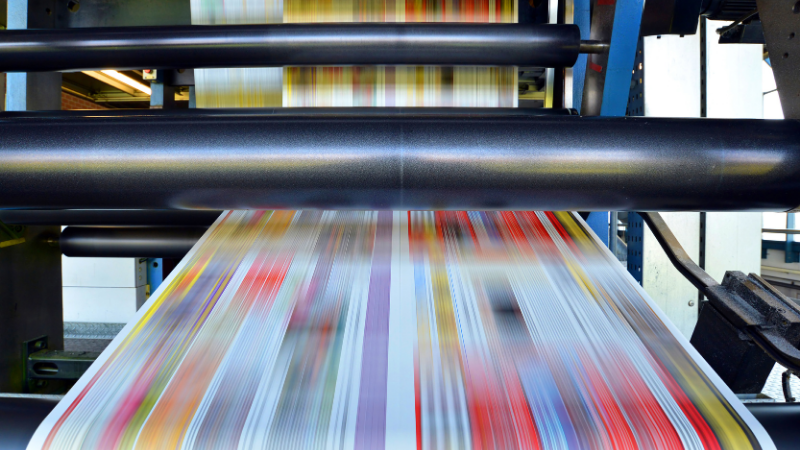
The magic behind AOP is dye sublimation printing. In this process, specialized inks are printed onto transfer paper and then subjected to intense heat and pressure. This causes the ink to turn directly into a gas, bonding permanently with the polyester fibers of the fabric. The result is a vibrant, fade-resistant print that won't crack or peel over time.

Feature All-Over Print (AOP) Direct-to-Garment (DTG)
Print Coverage 100% full-body coverage (seam-to-seam). Restricted to a specific, localized area.
Best Fabric Polyester and high-poly blends. 100% cotton or high-cotton blends.
Pros Maximum creative freedom; vivid, un-fading colors; no texture feel on ink. Great for precise, intricate details on soft cotton; cost-effective for simple graphics.
Cons Can occasionally leave tiny white streaks near seams/armpits if printed pre-assembled. Limited design canvas; ink can feel heavy if the graphic is large.

Best Design Types for AOP
Because the canvas is unlimited, certain aesthetics perform exceptionally well with all-over printing:

Seamless Patterns & Textures: Floral, geometric, animal prints, and repeating logos that flow beautifully across seams.
Large-Scale Photography: High-resolution landscapes, galaxy prints, or cityscapes that wrap around the wearer.
Athletic & Sportswear: Bold racing stripes, team gradients, and high-energy jerseys.
Abstract & Psychedelic Art: Fluid art, tie-dye effects, and vibrant digital graphics that demand attention.

Why Sell Custom All-Over Print Shirts in 2026?

The global custom t-shirt printing market is experiencing explosive growth, with valuations reaching approximately $6.57 billion in 2026. Driven by a surge in consumer demand for highly personalized apparel, this momentum creates a golden opportunity for print-on-demand sellers.

Because of their seamless design and premium feel, all-over print shirts easily command higher retail prices than standard graphic tees. This unlocks substantial profit margins for e-commerce brands looking to scale.

Furthermore, AOP products appeal to a highly diverse and passionate audience. They are a staple in high-demand niches, including:

Athletic Wear & Team Uniforms: Bold jerseys that require continuous patterns.
Streetwear Brands: Cutting-edge, eye-catching fashion statements.
Artist Merchandise: Transforming canvas paintings or digital illustrations into wearable art.
Holiday & Seasonal Themes: Vibrant, all-over prints for festive celebrations.

Partnering with Inkedjoy makes capitalizng on this lucrative trend entirely risk-free. As a reliable print on demand platform, Inkedjoy eliminates the burden of upfront inventory and enforces no minimum order quantities (MOQ).

Every order is automatically manufactured and sent directly to your customer via global dropshipping, allowing you to focus purely on marketing and design while your business runs on autopilot.

Step-by-Step: How to Make Custom All-Over Print Shirts with Inkedjoy

Creating eye-catching sublimated apparel is incredibly straightforward when you partner with the right print-on-demand manufacturer.

Inkedjoy provides an intuitive ecosystem that streamlines everything from initial product customization to automated backend logistics. Follow this definitive, step-by-step guide to bring your all-over print design ideas to life.

Step 1: Set Up Your Inkedjoy Account and Store
Getting started with Inkedjoy is entirely free and takes only a few minutes. To begin, visit the official website and sign up for a free merchant account. Once your dashboard is ready, the next step is connecting your e-commerce storefront. Inkedjoy offers seamless integration with industry-leading e-commerce platforms, including Shopify, Etsy, WooCommerce, and TikTok Shop.

how to make aop shirts

By linking your online store, you unlock a completely hands-free fulfillment workflow. When a customer purchases a custom AOP shirt from your shop, the order details, customer shipping address, and print files are automatically synced and routed to Inkedjoy's manufacturing facilities. Production starts without requiring any manual data entry from you.

Step 2: Choose the Right AOP Product
Selecting the perfect garment base is critical for balancing print brilliance and wearing comfort. Inkedjoy's extensive catalog features diverse options for cut-and-sew apparel:

100% Polyester Fabrics: Ideal for sportswear, jerseys, and high-energy streetwear. Polyester fibers bond perfectly with sublimation inks, resulting in the most vibrant colors and sharpest details possible.
Polyester-Spandex/Cotton Blends: Perfect for everyday lifestyle apparel. These blends provide a premium, buttery-soft hand feel and excellent stretch while still retaining enough poly-content to capture vivid colors.

When browsing the product catalog, always review the critical technical specifications listed on the product page. Pay close attention to the fabric weight (GSM), comprehensive size charts, and specific print file template requirements (such as DPI and bleed margins) to ensure your artwork matches the garment proportions flawlessly.

Step 3: Design Your Artwork in the Inkedjoy Design Tool
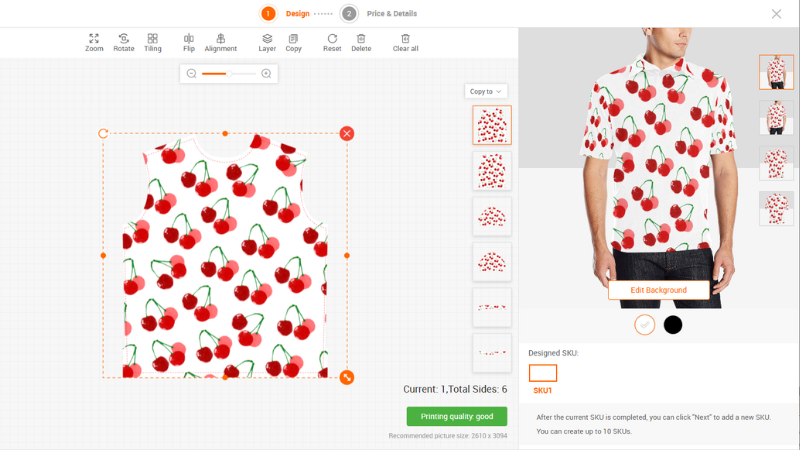
Once you select your base shirt, launch Inkedjoy's advanced Mockup Generator and upload your high-resolution artwork (ideally 300 DPI in PNG or TIFF format). The interactive design tool allows you to easily scale, rotate, and tile your graphics across the entire canvas.
all over print shirts

Because cut-and-sew sublimation prints individual fabric panels before stitching them together, you can independently inspect and customize every single perspective: the front panel, back panel, left sleeve, right sleeve, and collar.

For a truly professional finish, ensure that critical graphic elements—such as text, logos, or main character focal points—are placed safely away from the seam lines and armpits to avoid getting cut off. If you need creative inspiration, you can also utilize Inkedjoy's built-in library of design assets and trendy patterns.

Step 4: Review Mockups and Order a Sample
Before pushing your new creation live to the public, leverage Inkedjoy's high-fidelity 3D previews to visually inspect how the graphic wraps around the shoulders and joins at the seams. However, digital mockups can only show you so much. It is highly recommended to order a physical product sample for yourself.

Ordering a sample allows you to personally verify the color accuracy under natural light, feel the texture of the printed fabric, and test the sizing fit. Furthermore, you can use this physical sample to shoot high-quality, real-life photography and videos, which serve as authentic marketing materials for your social media ad campaigns.

Design Best Practices for All-Over Print Shirts

Creating a flawless all-over print shirt requires a slightly different approach than designing standard graphic tees. Because your artwork wraps around a three-dimensional body, mastering the technical aspects of textile design is essential. Follow these industry best practices to ensure your custom apparel looks just as stunning in reality as it does on your screen.

Use High-Resolution Files
The foundation of a premium print is file quality. Always create and export your artwork at a minimum of 300 DPI (Dots Per Inch) in PNG or TIFF format to preserve transparency and crisp details.

Because AOP shirts cover a massive surface area, your digital canvas must be scaled larger than the actual garment dimensions. Designing with a low-resolution file or attempting to upscale smaller images will result in pixelation, blurry edges, and a subpar final product.

Understand the Bleed Area and Safe Zones
When designing for cut-and-sew sublimated apparel, you will encounter templates with distinct layout boundaries:

The Bleed Area: This is the outermost edge of the template. Your background colors, patterns, and textures must extend all the way to fill this zone. This ensures that when the fabric panels are cut out, there are no unprinted white borders left along the edges.
The Safe Zone: This is the inner perimeter of the template. Keep all critical elements—such as brand logos, typography, and primary graphic focal points—securely inside this area so they are never cut off during assembly or lost in the seams.

Pick the Right Design Style for AOP
Certain design aesthetics translate beautifully to the full-canvas format of AOP shirts, while others present technical challenges.

all over print shirts

What Works Best: Seamless repeating patterns, fluid gradients, abstract digital art, and large botanical or geometric motifs. These styles flow naturally across separate fabric panels.
What to Avoid: Avoid designs that rely on exact alignment across seams, such as horizontal stripes that wrap from the chest to the sleeve, or fine-line text that spans across the collar. For photographic designs, ensure the main subject is centered and away from the garment edges to prevent awkward distortion.

Color and Contrast Tips
Sublimation printing on polyester fabric yields incredibly vibrant, saturated colors and deep contrasts. To maximize visual impact, utilize rich color palettes and check your design's depth by viewing it in grayscale to ensure the contrast holds up.

It is important to note that very dark or solid black designs carry a minor risk of revealing tiny white streaks near heavy creasing, such as under the armpits, if printed pre-assembled. Opting for busy patterns or multi-colored backgrounds helps naturally mask these mechanical print variances.

How to Sell Your Custom All-Over Print Shirts Successfully

Launching your custom apparel brand is only the first step; driving consistent sales requires a strategic approach to e-commerce marketing and operations. Because sublimated apparel carries a high-perceived value, your storefront must reflect that premium quality across every touchpoint. Here is how to position, price, and promote your all-over print shirts to maximize your revenue.

Write Compelling Product Descriptions
An effective product description does more than list features—it paints a picture of ownership. Highlight the premium seamless aesthetic of the all-over print, the lightweight breathability of the fabric, and the versatile settings where customers can wear it.

Always embed a clear, detailed size chart and precise care instructions (like machine washing inside out) to minimize returns. To save you time, Inkedjoy provides automated description templates directly inside your dashboard, which you can easily customize to match your brand's unique voice.

Use High-Quality Visuals
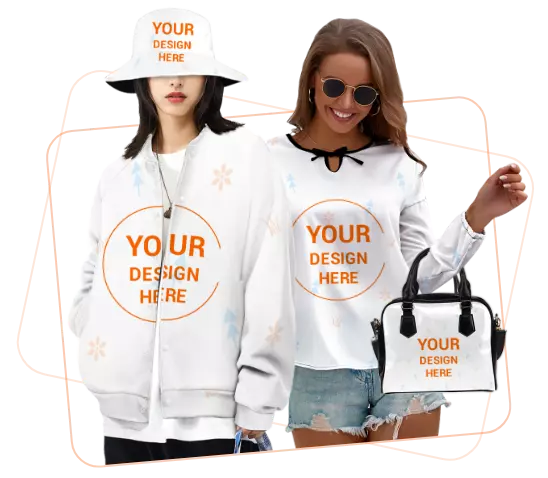
In the online fashion world, imagery is your ultimate sales closer. Populating your storefront with clean, multi-angle 3D mockups gives buyers a comprehensive view of how your design flows from front to back.

Elevate your product listings further by uploading lifestyle photos of your physical product samples in real-world settings. Incorporating short video clips that display the garment's movement and fabric drape builds immense trust. You can generate these high-fidelity graphics using Inkedjoy's advanced mockup generator tool with just a few clicks.
how to make aop shirts

Price for Profit
To build a sustainable e-commerce business, you must implement a structured pricing formula:

Retail Price = Product Base Cost + Shipping Fees + Platform Transaction Fees + Your Desired Profit Margin

Because AOP shirts feature an elite, full-canvas design, you can confidently position them as premium luxury items, commanding higher prices than basic graphic tees. To boost your average order value (AOV), experiment with bundle discounts (e.g., "Buy 2, Get 15% Off") or seasonal promotional campaigns.

Market Your AOP Shirts
To drive consistent traffic, leverage highly visual social media platforms like Instagram and TikTok, showcasing your shirts through engaging transitions and styling videos. Optimize your online store's SEO by naturally incorporating high-intent keywords into your product titles, description copies, and image alt tags.

Furthermore, maximize your brand's reach by launching targeted email marketing flows, collaborating with niche micro-influencers, and displaying genuine customer reviews directly on your landing pages to establish solid social proof.

Conclusion

Building a successful apparel brand comes down to a few core execution steps. First, you must select the right premium fabrics and prepare high-resolution design files that fill the bleed areas.

Finally, ensure your focal points stay away from the seams and test physical samples to guarantee flawless quality. Coupled with a strategic pricing and marketing strategy, all-over print shirts offer a highly lucrative avenue to scale your e-commerce business.

There is no better time to tap into this high-margin market. Head over to Inkedjoy today to explore our extensive AOP product catalog, sign up for your free merchant account, and launch your custom all-over print clothing brand.


FAQ

What is an all-over print shirt?

An all-over print (AOP) shirt features a continuous design that covers 100% of the garment—including the front, back, and sleeves—rather than being confined to a single localized area.

What fabric is best for all-over printing?

Polyester and polyester-blend fabrics are ideal for AOP. Sublimation inks bond perfectly with synthetic fibers, resulting in vibrant colors that will not crack or peel.

What file format and resolution do I need for designs?

For crisp print results, upload your artwork in PNG or TIFF format at a minimum of 300 DPI, ensuring the graphic extends to fill the entire bleed area template.

I

Written By Iris

As a writer for Inkedjoy, Iris helps print-on-demand sellers discover new trends and popular products to sell from their online stores. She provides useful tips and brand-building strategies so creators can work smarter and connect with customers globally for long-term growth.

Like the article

0
How to Make Custom All-Over Print Shirts

How to Make Custom All-Over Print Shirts

Key Takeaways

  • All-Over Print (AOP) shirts enable maximum creativity with seamless, full-surface designs unlike traditional limited-area printing.
  • Dye sublimation on polyester fabrics delivers vibrant, fade-resistant prints that won't crack or peel.
  • AOP shirts command higher retail prices and profit margins in the growing custom apparel market.
  • Inkedjoy provides premium manufacturing, cut-and-sew production, and automated fulfillment with no inventory or MOQ.
  • Success comes from high-resolution designs, proper bleed/safe zones, and strategic marketing on platforms like TikTok and Instagram.

The custom apparel market is experiencing a massive shift, and All-Over Print (AOP) shirts are leading the charge. Unlike traditional screen printing that limits designs to a small chest area, AOP unleashes maximum creativity by sublimating vibrant, seamless artwork across every single inch of the fabric.

For e-commerce entrepreneurs, this trend represents a highly lucrative business opportunity to stand out in a crowded print-on-demand landscape.

However, mastering the seamless setup of all-over graphics can be challenging. That is where Inkedjoy steps in as your ultimate print-on-demand partner, offering premium-quality manufacturing and automated fulfillment. In this comprehensive guide, we will take you step-by-step through the entire process of designing, creating, and successfully selling your own custom all-over print shirts.

What is an All-Over Print Shirt?

An All-Over Print (AOP) shirt is a garment where the design covers the entire surface—including the front, back, sleeves, and collar—leaving no blank fabric behind. This drastically differs from traditional Direct-to-Garment (DTG) printing, which is limited to a localized rectangle on the chest or back.

all over print shirts

The magic behind AOP is dye sublimation printing. In this process, specialized inks are printed onto transfer paper and then subjected to intense heat and pressure. This causes the ink to turn directly into a gas, bonding permanently with the polyester fibers of the fabric. The result is a vibrant, fade-resistant print that won't crack or peel over time.

Feature All-Over Print (AOP) Direct-to-Garment (DTG)
Print Coverage 100% full-body coverage (seam-to-seam). Restricted to a specific, localized area.
Best Fabric Polyester and high-poly blends. 100% cotton or high-cotton blends.
Pros Maximum creative freedom; vivid, un-fading colors; no texture feel on ink. Great for precise, intricate details on soft cotton; cost-effective for simple graphics.
Cons Can occasionally leave tiny white streaks near seams/armpits if printed pre-assembled. Limited design canvas; ink can feel heavy if the graphic is large.

Best Design Types for AOP
Because the canvas is unlimited, certain aesthetics perform exceptionally well with all-over printing:

Seamless Patterns & Textures: Floral, geometric, animal prints, and repeating logos that flow beautifully across seams.
Large-Scale Photography: High-resolution landscapes, galaxy prints, or cityscapes that wrap around the wearer.
Athletic & Sportswear: Bold racing stripes, team gradients, and high-energy jerseys.
Abstract & Psychedelic Art: Fluid art, tie-dye effects, and vibrant digital graphics that demand attention.

Why Sell Custom All-Over Print Shirts in 2026?

The global custom t-shirt printing market is experiencing explosive growth, with valuations reaching approximately $6.57 billion in 2026. Driven by a surge in consumer demand for highly personalized apparel, this momentum creates a golden opportunity for print-on-demand sellers.

Because of their seamless design and premium feel, all-over print shirts easily command higher retail prices than standard graphic tees. This unlocks substantial profit margins for e-commerce brands looking to scale.

Furthermore, AOP products appeal to a highly diverse and passionate audience. They are a staple in high-demand niches, including:

Athletic Wear & Team Uniforms: Bold jerseys that require continuous patterns.
Streetwear Brands: Cutting-edge, eye-catching fashion statements.
Artist Merchandise: Transforming canvas paintings or digital illustrations into wearable art.
Holiday & Seasonal Themes: Vibrant, all-over prints for festive celebrations.

Partnering with Inkedjoy makes capitalizng on this lucrative trend entirely risk-free. As a reliable print on demand platform, Inkedjoy eliminates the burden of upfront inventory and enforces no minimum order quantities (MOQ).

Every order is automatically manufactured and sent directly to your customer via global dropshipping, allowing you to focus purely on marketing and design while your business runs on autopilot.

Step-by-Step: How to Make Custom All-Over Print Shirts with Inkedjoy

Creating eye-catching sublimated apparel is incredibly straightforward when you partner with the right print-on-demand manufacturer.

Inkedjoy provides an intuitive ecosystem that streamlines everything from initial product customization to automated backend logistics. Follow this definitive, step-by-step guide to bring your all-over print design ideas to life.

Step 1: Set Up Your Inkedjoy Account and Store
Getting started with Inkedjoy is entirely free and takes only a few minutes. To begin, visit the official website and sign up for a free merchant account. Once your dashboard is ready, the next step is connecting your e-commerce storefront. Inkedjoy offers seamless integration with industry-leading e-commerce platforms, including Shopify, Etsy, WooCommerce, and TikTok Shop.

how to make aop shirts

By linking your online store, you unlock a completely hands-free fulfillment workflow. When a customer purchases a custom AOP shirt from your shop, the order details, customer shipping address, and print files are automatically synced and routed to Inkedjoy's manufacturing facilities. Production starts without requiring any manual data entry from you.

Step 2: Choose the Right AOP Product
Selecting the perfect garment base is critical for balancing print brilliance and wearing comfort. Inkedjoy's extensive catalog features diverse options for cut-and-sew apparel:

100% Polyester Fabrics: Ideal for sportswear, jerseys, and high-energy streetwear. Polyester fibers bond perfectly with sublimation inks, resulting in the most vibrant colors and sharpest details possible.
Polyester-Spandex/Cotton Blends: Perfect for everyday lifestyle apparel. These blends provide a premium, buttery-soft hand feel and excellent stretch while still retaining enough poly-content to capture vivid colors.

When browsing the product catalog, always review the critical technical specifications listed on the product page. Pay close attention to the fabric weight (GSM), comprehensive size charts, and specific print file template requirements (such as DPI and bleed margins) to ensure your artwork matches the garment proportions flawlessly.

Step 3: Design Your Artwork in the Inkedjoy Design Tool
Once you select your base shirt, launch Inkedjoy's advanced Mockup Generator and upload your high-resolution artwork (ideally 300 DPI in PNG or TIFF format). The interactive design tool allows you to easily scale, rotate, and tile your graphics across the entire canvas.

all over print shirts

Because cut-and-sew sublimation prints individual fabric panels before stitching them together, you can independently inspect and customize every single perspective: the front panel, back panel, left sleeve, right sleeve, and collar.

For a truly professional finish, ensure that critical graphic elements—such as text, logos, or main character focal points—are placed safely away from the seam lines and armpits to avoid getting cut off. If you need creative inspiration, you can also utilize Inkedjoy's built-in library of design assets and trendy patterns.

Step 4: Review Mockups and Order a Sample
Before pushing your new creation live to the public, leverage Inkedjoy's high-fidelity 3D previews to visually inspect how the graphic wraps around the shoulders and joins at the seams. However, digital mockups can only show you so much. It is highly recommended to order a physical product sample for yourself.

Ordering a sample allows you to personally verify the color accuracy under natural light, feel the texture of the printed fabric, and test the sizing fit. Furthermore, you can use this physical sample to shoot high-quality, real-life photography and videos, which serve as authentic marketing materials for your social media ad campaigns.

Design Best Practices for All-Over Print Shirts

Creating a flawless all-over print shirt requires a slightly different approach than designing standard graphic tees. Because your artwork wraps around a three-dimensional body, mastering the technical aspects of textile design is essential. Follow these industry best practices to ensure your custom apparel looks just as stunning in reality as it does on your screen.

Use High-Resolution Files
The foundation of a premium print is file quality. Always create and export your artwork at a minimum of 300 DPI (Dots Per Inch) in PNG or TIFF format to preserve transparency and crisp details.

Because AOP shirts cover a massive surface area, your digital canvas must be scaled larger than the actual garment dimensions. Designing with a low-resolution file or attempting to upscale smaller images will result in pixelation, blurry edges, and a subpar final product.

Understand the Bleed Area and Safe Zones
When designing for cut-and-sew sublimated apparel, you will encounter templates with distinct layout boundaries:

The Bleed Area: This is the outermost edge of the template. Your background colors, patterns, and textures must extend all the way to fill this zone. This ensures that when the fabric panels are cut out, there are no unprinted white borders left along the edges.
The Safe Zone: This is the inner perimeter of the template. Keep all critical elements—such as brand logos, typography, and primary graphic focal points—securely inside this area so they are never cut off during assembly or lost in the seams.

Pick the Right Design Style for AOP
Certain design aesthetics translate beautifully to the full-canvas format of AOP shirts, while others present technical challenges.

all over print shirts

What Works Best: Seamless repeating patterns, fluid gradients, abstract digital art, and large botanical or geometric motifs. These styles flow naturally across separate fabric panels.
What to Avoid: Avoid designs that rely on exact alignment across seams, such as horizontal stripes that wrap from the chest to the sleeve, or fine-line text that spans across the collar. For photographic designs, ensure the main subject is centered and away from the garment edges to prevent awkward distortion.

Color and Contrast Tips
Sublimation printing on polyester fabric yields incredibly vibrant, saturated colors and deep contrasts. To maximize visual impact, utilize rich color palettes and check your design's depth by viewing it in grayscale to ensure the contrast holds up.

It is important to note that very dark or solid black designs carry a minor risk of revealing tiny white streaks near heavy creasing, such as under the armpits, if printed pre-assembled. Opting for busy patterns or multi-colored backgrounds helps naturally mask these mechanical print variances.

How to Sell Your Custom All-Over Print Shirts Successfully

Launching your custom apparel brand is only the first step; driving consistent sales requires a strategic approach to e-commerce marketing and operations. Because sublimated apparel carries a high-perceived value, your storefront must reflect that premium quality across every touchpoint. Here is how to position, price, and promote your all-over print shirts to maximize your revenue.

Write Compelling Product Descriptions
An effective product description does more than list features—it paints a picture of ownership. Highlight the premium seamless aesthetic of the all-over print, the lightweight breathability of the fabric, and the versatile settings where customers can wear it.

Always embed a clear, detailed size chart and precise care instructions (like machine washing inside out) to minimize returns. To save you time, Inkedjoy provides automated description templates directly inside your dashboard, which you can easily customize to match your brand's unique voice.

Use High-Quality Visuals
In the online fashion world, imagery is your ultimate sales closer. Populating your storefront with clean, multi-angle 3D mockups gives buyers a comprehensive view of how your design flows from front to back.

Elevate your product listings further by uploading lifestyle photos of your physical product samples in real-world settings. Incorporating short video clips that display the garment's movement and fabric drape builds immense trust. You can generate these high-fidelity graphics using Inkedjoy's advanced mockup generator tool with just a few clicks.

how to make aop shirts

Price for Profit
To build a sustainable e-commerce business, you must implement a structured pricing formula:

Retail Price = Product Base Cost + Shipping Fees + Platform Transaction Fees + Your Desired Profit Margin

Because AOP shirts feature an elite, full-canvas design, you can confidently position them as premium luxury items, commanding higher prices than basic graphic tees. To boost your average order value (AOV), experiment with bundle discounts (e.g., "Buy 2, Get 15% Off") or seasonal promotional campaigns.

Market Your AOP Shirts
To drive consistent traffic, leverage highly visual social media platforms like Instagram and TikTok, showcasing your shirts through engaging transitions and styling videos. Optimize your online store's SEO by naturally incorporating high-intent keywords into your product titles, description copies, and image alt tags.

Furthermore, maximize your brand's reach by launching targeted email marketing flows, collaborating with niche micro-influencers, and displaying genuine customer reviews directly on your landing pages to establish solid social proof.

Conclusion

Building a successful apparel brand comes down to a few core execution steps. First, you must select the right premium fabrics and prepare high-resolution design files that fill the bleed areas.

Finally, ensure your focal points stay away from the seams and test physical samples to guarantee flawless quality. Coupled with a strategic pricing and marketing strategy, all-over print shirts offer a highly lucrative avenue to scale your e-commerce business.

There is no better time to tap into this high-margin market. Head over to Inkedjoy today to explore our extensive AOP product catalog, sign up for your free merchant account, and launch your custom all-over print clothing brand.


FAQ

What is an all-over print shirt?

An all-over print (AOP) shirt features a continuous design that covers 100% of the garment—including the front, back, and sleeves—rather than being confined to a single localized area.

What fabric is best for all-over printing?

Polyester and polyester-blend fabrics are ideal for AOP. Sublimation inks bond perfectly with synthetic fibers, resulting in vibrant colors that will not crack or peel.

What file format and resolution do I need for designs?

For crisp print results, upload your artwork in PNG or TIFF format at a minimum of 300 DPI, ensuring the graphic extends to fill the entire bleed area template.

I

Written By Iris

As a writer for Inkedjoy, Iris helps print-on-demand sellers discover new trends and popular products to sell from their online stores. She provides useful tips and brand-building strategies so creators can work smarter and connect with customers globally for long-term growth.

Like the article

0