
How to Start a Streetwear Brand without Inventory in 2026
Want to start a streetwear brand in 2026 but don't have a factory, a big budget, or a warehouse full of stock? That's fine. You don't need any of those to begin.
Print on demand (POD) makes it possible to test designs, take orders, and have products printed and shipped only after a customer buys.
Through this article, you'll learn how to validate your niche, test your products, get your first orders, and scale your brand.
- Print on demand lets you start a streetwear brand with no upfront inventory, no MOQ, and no bulk risk.
- A strong streetwear brand is built on community, identity, and a clear visual language—not just graphics.
- POD margins are thinner than bulk ordering, but the low-risk model makes it ideal for testing designs and demand.
- Launching small, learning fast, and scaling what works can help reduce upfront risk and unnecessary spending.
What Makes a Brand Streetwear?
You need more than an appreciation of streetwear to launch a brand. Day one, the business has to be treated seriously. A strong community of people who identify with it will always be present in the case of a streetwear brand that does well.
While streetwear can take many forms, successful brands often share a few common characteristics:
- The people who wear this clothing have a clear sense of identity and individualism
- An obvious relationship with a particular culture, community, or environment, e.g., local music scene, skate parks, etc.
- You can instantly identify the visual language through fonts, colors, and graphics
- References to influences such as skate culture, hip-hop, Japanese fashion, vintage wear, or video games
- A product is supported not only with a great logo but with a story and character.
A clear message, recognizable visual language, and connection with a specific community can give a streetwear brand more than a product to sell.
Choose a Streewear Production Method
Traditional methods like ordering in bulk require you to purchase inventory upfront, before you even know whether customers will like your designs.
Using print on demand reverses the process - you design and publish your product online, then you receive the payment from the client, followed by printing and shipping the item after the transaction is made.
| Mthod | Inventory | MOQ | Lead Times | Design Complexity | Best For |
|---|---|---|---|---|---|
| Print on Demand | None held by you | 0, print per order | 3 to 10 days per order | Simple to moderate graphics | New brands testing demand |
| Bulk Ordering | Full stock upfront | Often 50 to 500 units | 2 to 6 weeks | Simple to moderate | Brands with proven demand |
| Cut and Sew | Full stock upfront | Often 100+ units per style | 6 to 16 weeks | Custom patterns and fits | Established brands, unique cuts |
The right production method depends on how much control you need, how much you can invest upfront, and whether you have already proven demand. For a new brand, POD can be used to validate designs before moving into larger production runs.
Take ARETE Streetwear. Founder Alex started small — blank shirts, a local printer, shipping orders himself. But once he was holding inventory, it got harder to expand into new designs, colors, and sizes. Switching to on-demand production gave him more room to grow, without the same inventory risk.
When Should You Move Beyond POD?
Consider moving to private-label or bulk production when a few designs consistently sell, you need custom fits or fabrics, or larger order volumes make lower per-unit costs more important.
For a new streetwear brand, there’s no need to make that decision upfront. Use POD to see what customers actually buy, then invest in larger production runs once you have products worth scaling.
How to Start a Streetwear Brand From Scratch in 5 Steps
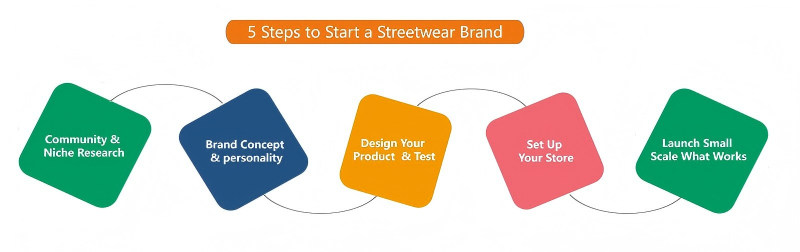
Step 1. Start With Your Community and Niche
Streetwear shoppers are often buying more than a garment. The style can become part of how they express their identity and connect with a particular culture or community. Start by deciding who you want to design for:
- Age, lifestyle, and hobbies
- Cultural and aesthetic influences
- Values and topics the community cares about
- What local brands are doing well
- What customers still feel is missing
One example is Teddy Fresh. Founder Hila Klein couldn't find clothes she actually wanted to wear — colorful, playful, well-made, and not overpriced. So she pulled ideas from kids' clothing, vintage pieces, and higher-end brands, and built her own line around that mix.
And you have several ways to research your target streetwear audience:
Online:
- Facebook groups related to your target streetwear style
- Reddit threads and niche communities
- Instagram community accounts and style-focused pages
In person:
- Streetwear trade shows
- Brand pop-up events
- Local markets and theme meetups
Before producing a full collection, test your concept with the audience you want to reach. Post mockups, mood boards, or sample designs and pay attention to saves, comments, DMs, email sign-ups, or preorder interest—not just follower growth or likes.
If people interact with the idea but show no willingness to buy, treat that as a signal to refine the product rather than increase your production budget.
Step 2. Tell People Who You Are and What You Do
After understanding your audience, it is time to create a consistent visual identity for the brand. Pose the following questions to yourself:
- How would you describe your brand in one or two sentences?
- What kind of products do you want to create?
- What does wearing your clothing say about the customer's lifestyle?
- What does your ideal customer care about beyond the clothes themselves?
Once you have answered these questions, you can determine certain aspects:
- Brand concept: the core values and philosophy of the brand besides the physical products. What is it that you are really getting into besides just the products?
- Visual style: how the brand's image is going to be represented - including color palette, fonts, photography, logo design, etc., and the overall feeling of these choices.
- Brand personality: it could be that the brand is one of those that has a rebellious, edgy, fearless, playful, etc., kind of attitude.
- Positioning: your brand's competitive characteristics that you want the customers to associate with you as compared with other competitors.
Make your brand idea and your logo easy enough for people to remember after one look.
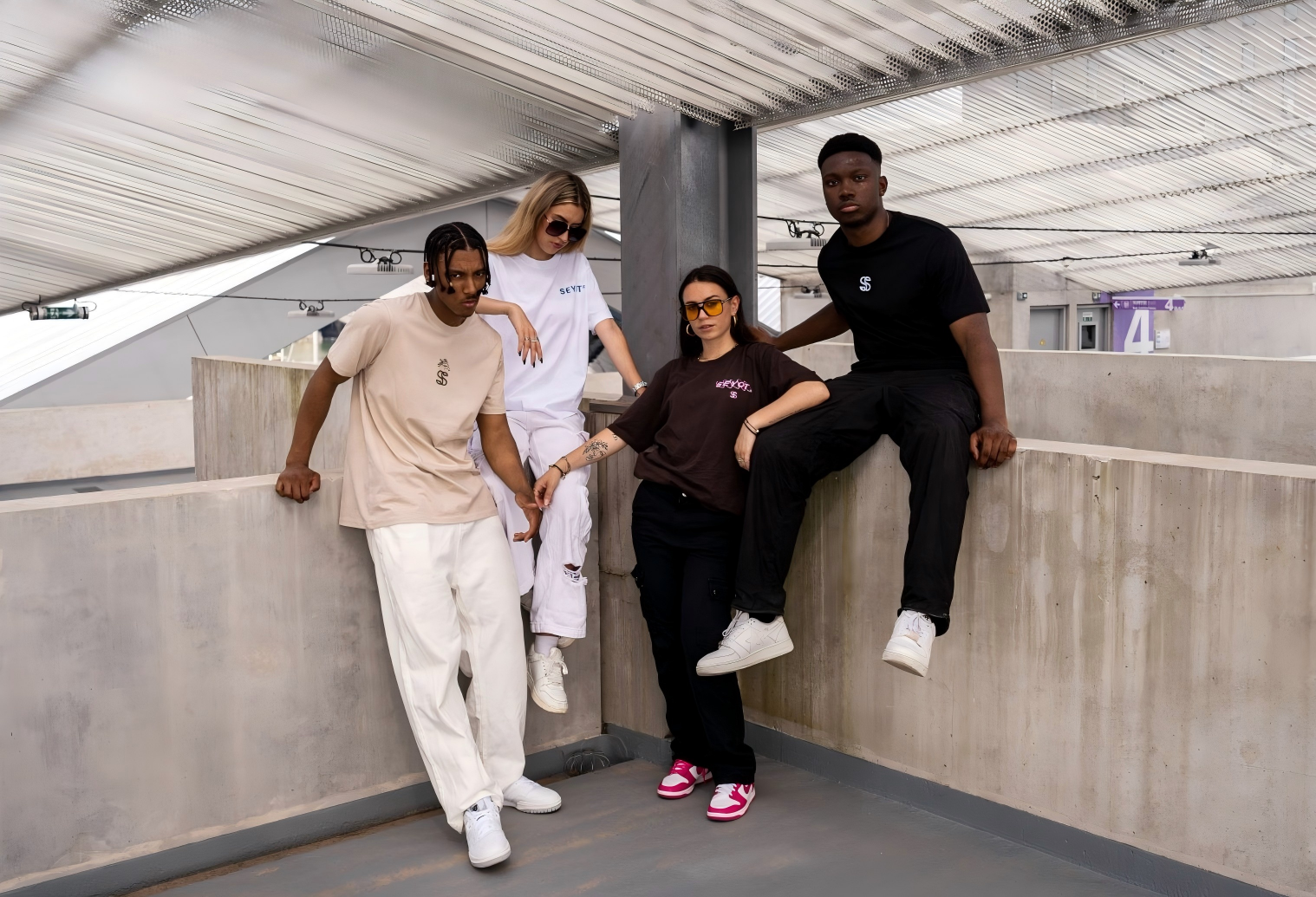
Step 3. Choose Your Products and Test Samples
Start with a small group of products that fit the identity of your brand rather than trying to sell everything at once. For example, an oversized T-shirt, hoodie, and sweatpants can give a new streetwear brand a consistent starting collection while keeping testing manageable. When choosing products and a supplier, pay attention to:
- Product quality: Check fabric, fit, sizing, stitching, and overall construction.
- Print quality: Make sure designs look clear, accurate, and consistent with your brand style.
- Unit cost: Compare product and fulfillment costs with your planned selling price and target margin.
- MOQ: For a new brand, low or no minimum orders make it easier to test products without committing to inventory.
- Fulfillment and shipping: Check production times, shipping costs, and available destinations.
- Customization: Consider whether you need custom labels, packaging, or other branding options.
- Supplier reliability: Look for clear quality-control processes and consistent fulfillment.
Before launching, order samples of your main products and test them yourself. Check the garment's fit and fabric, how the print looks after washing, and whether the finished product matches the quality your customers would expect.
The right printing method also depends on your design and product. DTG and DTF can work well for detailed graphics and smaller runs, while screen printing and embroidery may be better suited to certain designs or larger-volume orders. Focus on how the finished product supports your brand rather than choosing a method based only on cost.
According to Mordor Intelligence, 77.7% of streetwear consumers prioritize comfort and 67% prioritize quality. That makes fabric weight, fit, print clarity, and overall construction worth checking before you launch. For example, heavyweight blanks can help create a structured oversized look, while lighter fabrics may work better for a relaxed everyday style.
The goal at this stage isn't to build a complete collection. It's to find a small group of products that fit your brand, meet your quality expectations, and are worth testing with real customers.
Step 4. Set Up Your Store
The easiest way to launch your first store is to keep it as simple as possible. Choose a platform like Shopify, create a few clean product pages with sizing and materials, and highlight your pricing, shipping, and return policies. Before officially launching, thoroughly test the entire process from the product page to the checkout.
A single store paired with one powerful traffic channel is a less complicated management solution compared to being spread thin across five different platforms.
Step 5. Launch Small, Learn Fast, and Scale What Works
Start with a small drop of a few designs and limited products. This lets you see which styles get clicks, sales, or repeat interest before putting more money into production.A small launch is easier to manage and gives you faster feedback on which products and designs customers actually want.
Follow: 3–5 designs → 2–3 products → samples → storefront → launch → track sales → expand
Continue this way:
- Test your product design with a focused and limited launch
- Extract valuable insights from sales, customers' responses, products' effectiveness, and engagement with the content
- Tune up the underperformers or eliminate them entirely
- Extend and expand your products and channels that prove to be effective
Your marketing budget will be much better invested once you know which channels produce the most sales or which products are your bestsellers. Do this process repeatedly so you don't waste money on products that nobody wants before even finding out what your customers actually want.
How Much Does It Cost to Start a Streetwear Brand?
Starting a POD line is a lot cheaper than launching a traditional apparel line, but it still has financial requirements.
Streetwear Brand Startup Budget
| Expense | Starting range |
| Samples | $20–$100+ |
| Store fee | $0–$39+/month |
| Domain | $10–$20/year |
| Branding | $0–$150+ |
| Initial marketing | $0–$300+ |
| Inventory | $0 with POD |
Your starting cost depends heavily on whether you hold inventory. With POD, you can test designs without paying for a large production run upfront. For your first collection, here is what you can realistically expect in terms of expenses:
Product Samples:
When you order a basic white T-shirt sample from a POD supplier, it usually will cost you around $10 to $25 per piece (before you even consider the cost of design and printing the product).
Logo design:
Logo packages are offered on independent work sites such as Fiverr and Upwork. Starter options are often $20, with more extensive packages such as full brand identity packages available for $300 plus.
Website and store setup:
On Shopify, you can start a store around $29 to $39 a month. If you skip Shopify Payments, you will be charged a small fee on each transaction.
Marketing:
There are several ways to do content marketing, and one of them doesn't require you to fork out any money but only your time - that means if you're already working on a product that you think people will actually want to purchase, then you can get away with testing out paid posts for as little as $50.
Trademarks and business:
USPTO's Trademark Center charges $350 per class of goods for a federal trademark application using the pre-approved ID Manual. A free-form description and an absence detail add a surcharge to the base fee.
Forming an LLC requires a separate filing for each state and varies by how much you're charged by the state where you're registering your business. When registering your EIN via IRS.gov, you won't be charged anything.
In total, for a minimal streetwear launch with perhaps just one or two designs, you could probably expect to spend from $150 to $1,000 before you even have your first order.
Get Your Legal Basics in Place
Before launch, check these five basics:
- Business structure
- EIN requirements
- Trademark search
- Sales tax obligations
- Separate business and personal finances
Having a legal degree is not a condition for selling your product, but setting up some basic legal stuff before any problems appear will help protect you. Of course, this article is not offering legal advice, so if you have a special question, consult your legal professional first.
Business structure: Many small businesses start as sole proprietorships, while others choose an LLC for liability separation. The right structure depends on your circumstances, location, and business goals.
EIN: An Employer Identification Number (EIN) is a federal tax ID issued by the IRS. You may need one depending on your business structure and tax situation, and you can apply for one directly through the IRS for free.
Trademark search: Before investing heavily in a new brand name or logo, search the USPTO trademark database for potentially conflicting marks.
Sales tax basics: Sales tax obligations vary by state and depend on factors such as where your business operates and where you have sales tax nexus. Many major e-commerce platforms can calculate and collect sales tax on eligible orders, but you should still understand your own registration and filing responsibilities.
Keeping personal and business funds separate: it is quite difficult to do bookkeeping when business and personal finances are mixed, as they were before digital accounting. Having separate business bank accounts will also help to save you lots of time in filing your taxes.、
Also make sure your graphics, fonts, and other visual assets are original or properly licensed, and check the clothing labeling requirements that apply in your target market.
How to Get Your First Sale With a Small Budget
You don't need a large ad budget to get your first streetwear sale. Start with the channels where your target customers already spend time, then test paid promotion once you know which products get a response.
Create engaging social posts by sharing images and videos of you wearing your clothes, showcasing the design process, announcing product launches, and featuring content that will be of value to the followers in general and, most of all, those who share the culture of streetwear that you are representing. Just talking about your product does not usually attract much.
Get involved and promote the movement already going on: understand what is needed in your niche, and help by giving your opinion. You should start by giving others something and then promoting your business.
Marketing by creating with people who have a small but influential number of followers is really effective when your customer demographic matches theirs. Think about how you'll get exposure for your products through seeding free pieces to creators.
Give away referral fees: you'll attract more people without upfront marketing expenses if you reward your creators or fans whenever they make sales on your behalf.
Paid advertisements: once you have a design that you are sure people will love, use paid social ads to attract the right people in smaller quantities, and only increase the budget for the ones you are getting results on.
Offline engagement points: local activities, a sudden appearance with your line at a store, a collaboration with a streetwear creator, and a stylish lookbook all help to create a buzz that online exposure alone would never have been possible.
Common Mistakes to Avoid When Starting a Streetwear Brand
- Having too many products on your shelves instead of launching your first line
- Placing an order of your product based only on pre-orders or your gut feeling
- Literally mimicking the style and the aesthetic of the famous brand to attract the target audience rather than designing and building your identity.
- Reducing the manufacturing cost even though it comes at the expense of garment or printing quality
- Spending a lot on brand development without checking if your product is selling well.
- Believing that popularity, the number of followers, and likes mean sales.
Frequently Asked Questions
What do you need to start a streetwear brand?
Start a streetwear brand by finding your niche, getting an identity, making a design, and setting up an online store.
Is streetwear profitable?
Streetwear can be profitable. It depends on how you fulfill orders, price things, and know your niche. POD margins are tight compared to bulk, but there's less risk up front.
Can I start a streetwear brand with little money?
Yes, you can start a streetwear brand with little money. POD lets you use a few hundred bucks for samples, logo, and Shopify without bulk costs.
Do I need an LLC to start a clothing line?
Not necessarily. Many founders start as sole proprietors. LLCs come later if sales grow and liability protection matters.
Can I start a streetwear brand with no experience?
You can start a streetwear brand without experience. Research, a clear identity, and testing designs matter more than prior industry experience.
Can I start a streetwear brand without inventory?
Yes. Print on demand lets you start a streetwear brand without holding inventory. You print and ship each order only after customers buy the design.
Read more
Written by
Gina
A marketing specialist with experience in e-commerce, print-on-demand, and fashion. She has worked extensively with content around clothing products and emerging apparel brands, covering topics such as product selection, apparel trends, brand positioning, and custom printing. Her work combines market research, SEO, and product analysis to help online sellers turn fashion ideas into practical product and marketing strategies.